
As a fitness enthusiast, your grip strength should be top-notch so you can perform any possible exercise or workout.
Don’t you know how to increase your grip strength? Let us tell you that in order to do that, you have to have commitment, passion, and consistency.
And you need to be specific as well when your main objective is to improve your grip strength for pullups because it requires extreme strength and stamina.
However, a couple of grip-strengthening exercises and workouts can take your pullup strength to a new level.
Let’s get to know about them:
How To Improve Grip Strength For Pull Ups
Listed below are the best exercises to increase your hand grip strength for pull ups:
1. Hand Gripper Training
 A hand gripper is a spring-loaded device you squeeze repeatedly to work your fingers, palm, and forearm muscles, the exact muscles that hold you on the bar.
How to do it:
- Hold the gripper in one hand
- Squeeze it fully until both handles touch (or as close as you can get)
- Release slowly — don't just let it snap open
- Do 3 sets of 10–15 reps per hand
Why it works: The slow release (eccentric phase) builds the grip endurance that keeps you from slipping off the bar mid-set.
Start with a resistance level you can close for 10 reps with effort. Once that feels easy, move up. Gripzilla hand grippers come in multiple resistance levels so you can progress over time without hitting a wall.
2. Wrist Roller
 The wrist roller works both the top and bottom of your forearm, wrist extensors and flexors, which gives you a more balanced, stable grip.
How to do it:
- Hold the roller at shoulder height with arms extended
- Roll the weight up by rotating your wrists forward
- Then slowly lower it back down by reversing the motion
- Do 3 sets in each direction (forward and backward)
Why it works: Most grip exercises only work your finger flexors. The wrist roller adds forearm thickness and stability that makes your entire hand stronger.
The Gripzilla Dynamo is built specifically for wrist roller training, it loads and unloads smoothly and lets you track progress easily.
3. Dead Hangs

This is the most specific exercise for pull-up grip. You hang from the bar. That's it. Simple, but very effective.
How to do it:
- Grab a pull-up bar with an overhand grip, shoulder-width apart
- Hang with your arms fully extended
- Keep your shoulders engaged (don't let them shrug up to your ears)
- Hold for 30–60 seconds
- Rest 60 seconds, repeat 3–5 times
Why it works: Dead hangs train your grip in the exact position you use for pull-ups. They also decompress your spine, which is a bonus.
Progression: Once you hit 60 seconds comfortably, switch to a wider grip or use a towel over the bar to make it harder.
4. Towel Pull-Ups

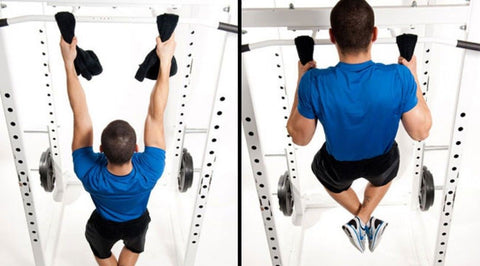
Towel pull-ups are regular pull-ups, but instead of gripping a bar, you grip a towel draped over it. This workout adds serious grip strength for pull ups.
How to do it:
- Drape two towels over your pull-up bar (one for each hand)
- Grip the hanging ends firmly
- Pull yourself up as you normally would
- Do 3–4 sets of as many reps as you can manage
Why it works: The towel's thickness and instability engage more muscles in your fingers and forearms compared to a standard bar grip.
If you're new to this, start with both hands on one towel until you build confidence.
5. Farmer's Carry

Pick up two heavy dumbbells or kettlebells and walk. That's the whole exercise, but it's one of the best full-body grip builders there is.
How to do it:
- Pick up a dumbbell in each hand (use a weight that's challenging but manageable)
- Stand tall, shoulders back
- Walk 20–30 metres at a steady pace
- Set them down, rest 60–90 seconds, repeat 3–4 times
Why it works: Your grip has to hold the weight for an extended time under load. Farmer's carry builds grip endurance and forearm strength that carries directly over to pull-ups.
Progression: Increase weight or walking distance as it gets easier.
6. Dumbbell Hold
 Sometimes the best exercise is the simplest one. Just hold dumbbells for time.
How to do it:
- Hold a dumbbell in each hand at your sides
- Stand straight, don't let your body sway
- Hold for 30–60 seconds
- Rest and repeat for 3 sets
Why it works: Static holds build the endurance in your finger flexors, the muscles responsible for keeping your grip locked during pull-ups.
Start light. The goal is time, not weight. Increase weight only when you can hold for 60 seconds without your form breaking down.
7. Plate Pinches

Plate pinches isolate the pinching muscles in your fingers, often the weakest link in an otherwise decent grip.
How to do it:
- Hold two weight plates together (smooth sides facing out) between your thumb and fingers
- Pinch them and hold for 20–30 seconds
- Do 3 sets per hand
Why it works: Pull-ups require your fingers to wrap and lock tightly around the bar. Plate pinches develop the small muscles in your fingers that make that lock stronger.
Start with lighter plates (5–10 lbs). It's harder than it looks.
8. Finger Extension Exercises
Most exercises train the closing motion of your hand. Finger extensions train the opening motion, which prevents imbalances, reduces injury risk, and actually makes your grip stronger overall.
How to do it:
- Place a rubber band around all five fingers
- Spread your fingers open against the resistance
- Do 3 sets of 15–20 reps per hand
Why it works: When your finger extensors are weak, your flexors (closing muscles) fatigue faster. Training both sides creates a balanced, more resilient grip.
You can also use a Gripzilla finger extensor band for more consistent resistance than standard rubber bands.
How Often Should You Train Grip?
Your forearm and hand muscles recover faster than larger muscle groups. A good starting schedule on how to improve grip strength for pull ups will be:
- 3 times per week (e.g., Monday, Wednesday, Friday)
- Train grip after your main workout, not before
- Give yourself at least one full rest day between grip sessions
Don't overdo volume early on. Start with 2–3 exercises per session and build from there.
Recap
We hope you have understood all the ways to increase your grip strength for pullups.
The discussed exercises and workouts could be performed inside the home, so the individuals who don’t like going outside after coming back from the offices can rely on them to see a significant boost in their pullup grip strength.
FAQs
How long does it take to improve grip strength for pull-ups?
Most people notice a difference in 4–6 weeks with consistent training (3x per week). Significant improvement typically takes 8–12 weeks.
Should I use gloves for pull-ups?
No, gloves reduce the tactile feedback between your hand and the bar, which can actually make grip training less effective. Train without gloves and build the calluses naturally.
Can I do grip training every day?
Not recommended, especially for beginners. Your muscles need recovery time. Stick to 3 days per week and rest in between.
Do pull-ups themselves improve grip strength?
Yes, but slowly. If grip is your weak point, dedicated grip exercises will get you there much faster.