This is an honest audit. The tools in this article are not bad. Spring grippers are in every dugout for a reason. Rice buckets have been part of baseball training for generations. Wrist rollers are a legitimate training implement. The problem isn't that these tools are wrong — it's that they're incomplete. And in baseball, incomplete forearm training is the same as no forearm training, because the sport demands both sides of your forearm simultaneously. Here's exactly what each tool trains, what it misses, and why the gap is costing you measurable performance.

| Tool | Trains Flexors | Trains Extensors | Bilateral Simultaneous Load | Progressive Overload | Verdict |
|---|---|---|---|---|---|
| Gripzilla Dynamo★ Editor's Pick Dual-directional wringing resistance | ✓ Full resistance | ✓ Full resistance simultaneously | ✓ Both sides in every rep | ✓ Adjustable dial — infinite progression | 2 of 2 sides — Complete ✓ |
| Spring Grippers Hand grippers, crush trainers | ✓ Strong | ✗ Not trained | ✗ One direction only | ◎ Fixed ratings only | 1 of 2 sides — Incomplete |
| Rice Bucket Classic baseball staple | ◎ Partial — low resistance | ◎ Partial — no targeted load | ✗ No meaningful bilateral load | ✗ No measurable progression | Partial — Gap Remains |
| Wrist Roller Cable / rope wrist roller | ◎ Moderate | ✗ Not trained | ✗ Shoulders fail first | ◎ Weight increments only | 1 of 2 sides — Incomplete |
| Wrist Curls (Barbell) Standard gym wrist curls | ✓ Strong | ◎ Partial only | ✗ Sequential, not simultaneous | ◎ Dumbbell increments | 1 of 2 sides — Incomplete |
The Audit in One Sentence: Every other tool trains one side of the forearm. The Dynamo trains both simultaneously — the only training motion that matches what a baseball swing actually demands. Here's the breakdown of exactly why each tool falls short 👇
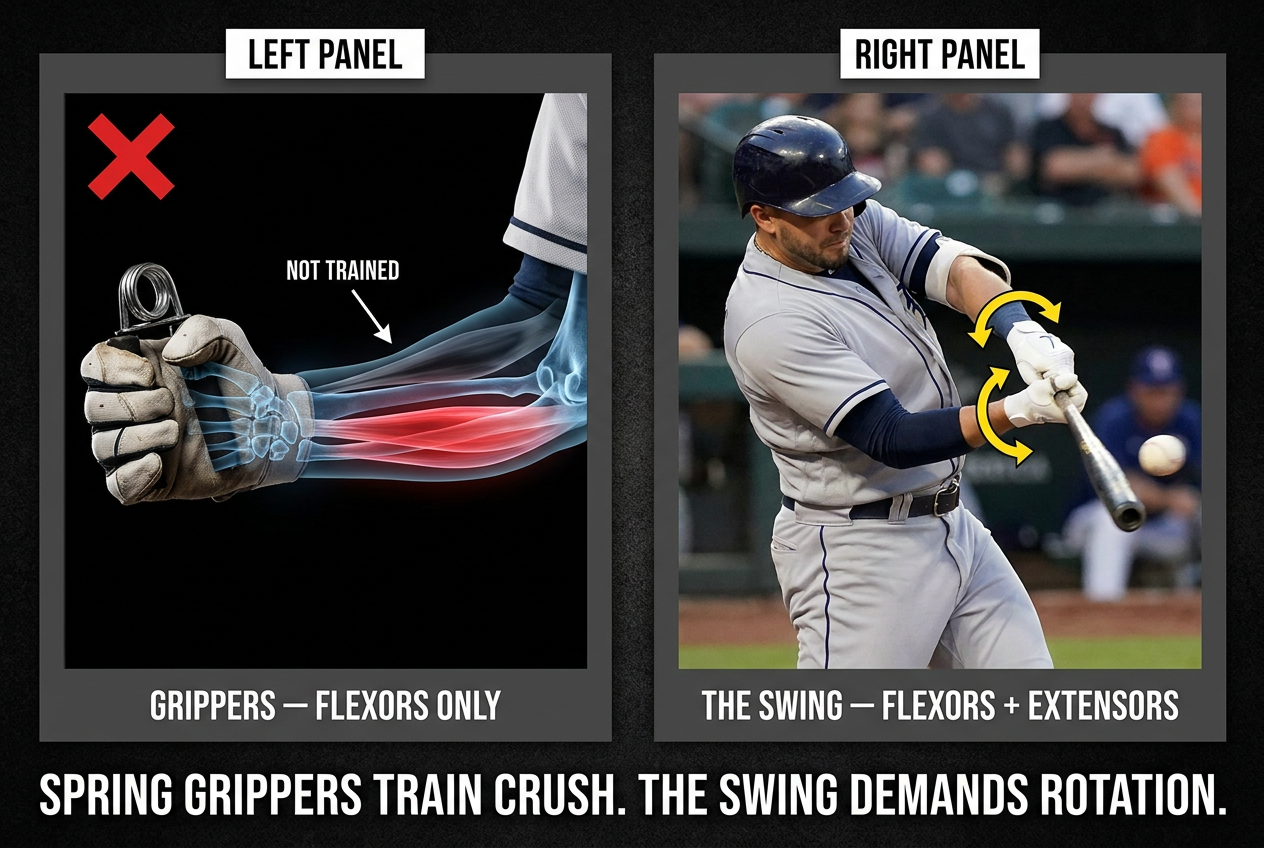
Spring grippers are the most common grip training tool in baseball. They're cheap, portable, and they do train something real — the flexor muscles that close the hand. If your only goal is a stronger handshake, a spring gripper is a perfectly adequate tool. The problem is that the baseball swing is not a handshake.
The swing requires both the flexors and the extensors to work simultaneously — one side drives the barrel through the zone, the other provides the stabilizing counterforce that keeps it there. Spring grippers train exactly the flexors. The extensors receive zero training stimulus. The result is a forearm that gets stronger on the closing side while the stabilizing side remains undertrained. The Extensor Gap widens with every rep.
The players who squeeze grippers in the dugout and wonder why their exit velocity isn't moving are experiencing the spring gripper gap. They're getting stronger at the one side that matters least in the swing, while the side that actually controls barrel path through the zone remains completely untouched.

The rice bucket deserves credit. It's been in baseball training rooms for generations, and it does train something real. Finger endurance and basic forearm conditioning are both addressed. For a young player building forearm awareness for the first time, a rice bucket is a legitimate starting point. This audit gives it that credit.
But here's where the rice bucket falls short: it provides low-level, non-progressive resistance with no ability to specifically load the extensor side under meaningful force. You can do rice bucket drills for five minutes and feel a burn — but a burn isn't the same as progressive overload. Your grandmother could do rice bucket drills. You don't get stronger at something your grandmother can do.
The rice bucket gap is most visible in players who have been doing them consistently and still see their bat speed plateau. Their forearms feel conditioned. Their bilateral forearm strength — the balance between the flexors and extensors that determines barrel control through the zone — has not been specifically trained. The gap remains, and the exit velocity stays flat.
Every tool in this audit trains in one direction — they resist the closing motion of the hand, or the upward curl of the wrist, or the roll of a cable. The Gripzilla Dynamo's dual-directional wringing resistance system is mechanically different. Both hands grip the handles and twist in opposing directions — like wringing a wet towel. The internal resistance mechanism fights that motion in both directions simultaneously.
This means every rep loads the flexors in one direction and the extensors in the other at the same time. Not sequentially. Not on alternating sets. Simultaneously — in the same rep, every rep. This is the only training motion that mirrors the bilateral force demand of a baseball swing, where both sides of the forearm are working simultaneously at contact.
The adjustable resistance dial runs from Level 2 to Level 10 — appropriate from a 13U travel ball player just starting out to a college-level athlete in peak season. Every player closes the Extensor Gap at their own pace. Same tool. Same mechanism. Every rep, both sides.

Wrist rollers are a staple in strength and conditioning programs, and they do train forearm flexion effectively when used correctly. The problem is the body mechanics of the exercise itself: holding a weighted implement at arm's length while rolling it up and down requires significant shoulder and upper arm stabilization. For most players, the shoulders fatigue before the forearms reach meaningful training stimulus.
This is the wrist roller paradox — it's marketed as a forearm exercise, but the limiting factor is almost always the shoulder girdle. Players who use wrist rollers regularly often report shoulder fatigue and soreness without corresponding improvement in grip endurance or bat speed. They're training the wrong muscle group to failure while the forearms remain undertrained.
The Dynamo eliminates this problem entirely. Because it's held in a neutral position with the elbow at the side, the shoulder is not a limiting factor. Resistance is applied directly to the wrist joint in both directions, and the forearms reach meaningful training stimulus on every rep — without shoulder involvement. No soreness in the wrong place. All the work going to the right muscles.

The two sides of the forearm in baseball are not theoretical. They are measurable, trainable, and directly correlated with the performance metrics that scouts and coaches track. Exit velocity is driven by flexor force at contact. Barrel path consistency is driven by extensor stability through the zone. Bat speed endurance across a tournament weekend is driven by bilateral forearm conditioning.
When a player trains only the flexor side — which is what every tool in this audit except the Dynamo does — they build a forearm that is strong in the trained direction and weak in the untrained one. Under game-speed swing loads, the undertrained extensor side becomes the limiting factor. The barrel drops. The exit velocity plateaus. The swing that works in the first at-bat starts rolling over by the seventh.
These are not mechanical problems. They are not timing problems. They are forearm training gaps — and they are exactly the gaps that the Dynamo's dual-directional wringing mechanism is designed to close. Every rep loads both sides simultaneously. No other tool in this audit does that.
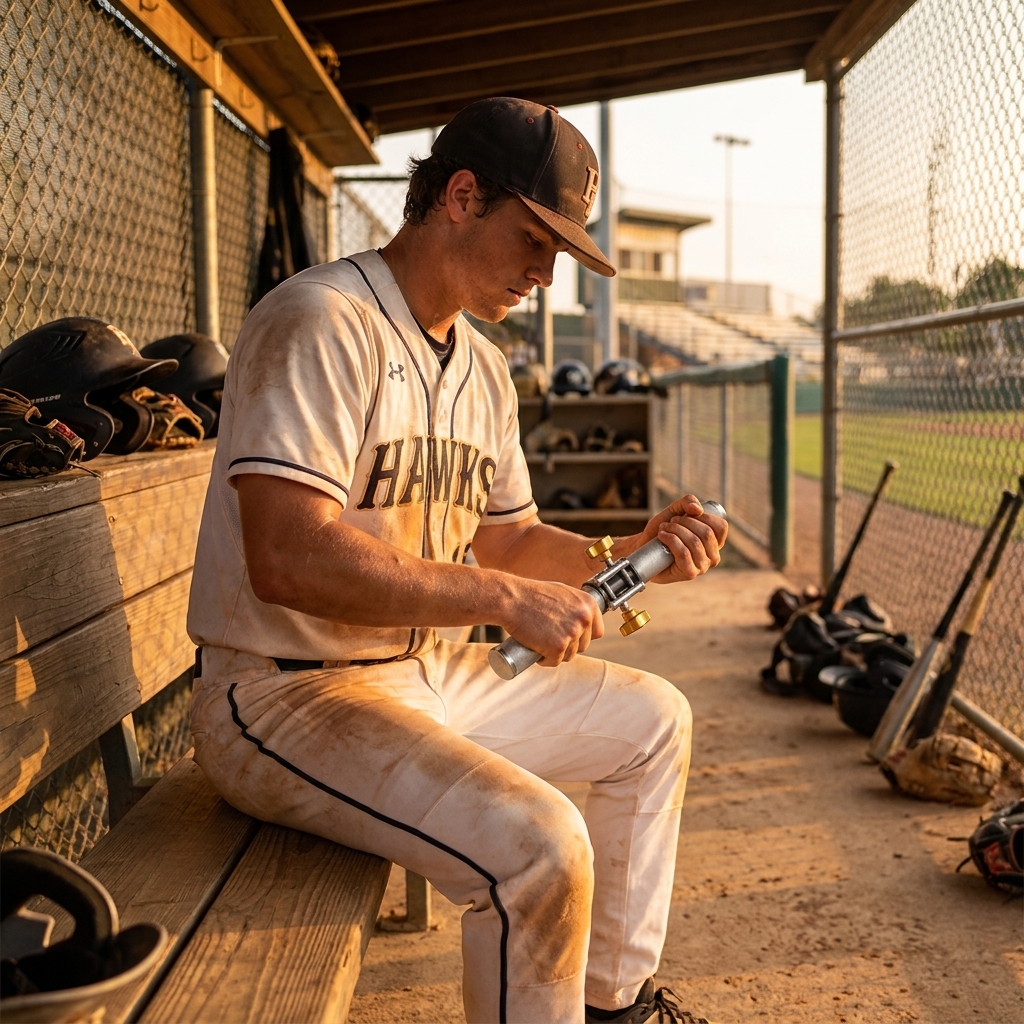
The audit is straightforward. Spring grippers train one side. Rice buckets provide partial conditioning with no progression. Wrist rollers train one side and fatigue the wrong muscle group first. Wrist curls train one side and require a gym. The Dynamo trains both sides simultaneously, fits in a bat bag, and can be used anywhere.
The dual-directional wringing mechanism is the key. Unlike every other tool in this audit, the Dynamo's internal resistance system creates opposing forces in both directions simultaneously — flexors loaded in one direction, extensors loaded in the other, in the same rep. The resistance dial adjusts from Level 2 (appropriate for a 13-year-old starting out) to Level 10 (appropriate for a college or professional-level athlete).
If you've already tried the other tools and haven't seen the exit velocity or bat speed gains you expected, this is the explanation. You were training one side with incomplete tools. The Dynamo trains both sides with the right tool — the only training motion that actually mirrors what the swing demands.