You know the drill. March through October. Weekend tournaments. Hotel rooms. Private lessons with a $120/hr hitting coach. Showcases you drove four hours to attend. Your family put $9,400 into this season. And your exit velocity is 83 mph — same as it was last October. The cage work is there. The mechanics are right. The effort isn't the problem. Here's what the entire budget missed.

| Budget Item | Avg. Annual Cost | Trains Exit Velo Directly | Addresses Forearm Imbalance | ROI |
|---|---|---|---|---|
| Tournament Fees | $3,800 | ✗ Exposure only | ✗ | High if numbers are there |
| Private Hitting Lessons | $2,400 | ◎ Mechanics only | ✗ | Plateaus when mechanics are clean |
| Team Fees / Travel | $2,200 | ✗ | ✗ | Reps and exposure |
| Equipment | $800 | ✗ | ✗ | Marginal |
| Showcase Entries | $200 | ✗ Measurement only | ✗ | Depends on the number |
| Gripzilla Dynamo★ Missing Piece | $119 | ✓ Directly — closes the Extensor Gap | ✓ Only tool that does | +5–7 MPH exit velo in 8 weeks ✓ |
The math: Your family invested $9,400 in a season. The one piece that directly addresses the forearm imbalance limiting your exit velocity costs $119. Here are the 5 reasons that $119 is the most important line item in next season's budget 👇

Every travel ball parent and player has felt this. Saturday morning, the bat is jumping. You're squaring pitches up. Exit velo is where it should be. By Sunday afternoon of a two-day tournament — same mechanics, same pitcher quality, same effort — the ball just doesn't carry. You're rolling over pitches you barreled on Saturday. Your coach tells you it's fatigue. It's not fatigue.
What's happening is biomechanically specific: your forearms have accumulated a fatigue debt across Saturday's at-bats that one-sided training never prepared them for. The flexors — the side every grip tool you own trains — are still functioning. But the extensor side, which provides the stabilizing counterforce that keeps the barrel through the zone, was never trained to the same level. By Sunday afternoon, it's the limiting factor. The barrel drops. The exit velo drops.
The Dynamo's 8-week protocol specifically builds the bilateral forearm endurance that closes this gap — so your bat speed on Sunday afternoon is the same as Saturday morning. That's what the $9,400 budget couldn't buy, because no private lesson or tournament entry addresses the forearm imbalance that causes the drop.

At Perfect Game, PBR, and Prep Baseball events, players consistently show a 3–5 mph drop in exit velocity between their first and second hitting sessions. College coaches and scouts who attend multiple sessions in a day see this pattern constantly. It gets attributed to nerves settling in, or mechanical inconsistency, or "just one of those days." None of those explanations are accurate.
The real cause is the Extensor Gap reaching its limit under back-to-back high-intensity swing loads. The first session depletes the undertrained extensor side. The second session runs on reserves that aren't there. The scout who saw 88 mph in the morning sees 84 mph in the afternoon and doesn't invite you back. The 4 mph you left on the table wasn't mechanics. It was an undertrained side of your forearm.
Players who complete the 8-week Dynamo protocol before showcase season consistently report that their numbers stay flat across sessions — because both sides of the forearm have been trained to the same level. When both sides are balanced, there's no undertrained side to fatigue first. The exit velo that comes out in session one is the exit velo that comes out in session two.

This is the most common conversation in travel ball right now. The player's swing looks right on video. Hip rotation is there. Bat path is clean. Contact point is correct. Launch angle is optimized. The hitting coach has done everything right — and the exit velocity has been at 83 mph for two seasons. The coach is out of things to fix because the problem isn't in the swing.
The private lesson model is built around mechanics. It can fix a hitch. It can adjust a load. It can optimize launch angle. What it cannot do is address the bilateral forearm strength deficit that's physically preventing the swing from generating more bat speed at contact. You can have a perfect swing and still leave 5–7 mph on the table if the forearms that execute that swing are imbalanced.
The Dynamo closes the gap that private lessons can't reach. Not because it fixes mechanics — because it builds the bilateral forearm strength that makes the mechanics translate into exit velocity. Players who add the 8-week Dynamo protocol to an already-clean swing are the ones adding 5–7 mph seemingly out of nowhere. Their coaches notice before they say anything. That's not coincidence. That's the Extensor Gap closing.

When players make the jump between levels — JV to Varsity, 16U to 18U, travel ball to high school programs — coaches almost universally describe the same thing: "He just got stronger." What they're observing, without knowing the mechanism, is that the player's bilateral forearm strength caught up with their mechanics. The Extensor Gap closed. The swing that was already correct started producing the exit velocity it was always capable of.
This jump doesn't happen in the cage. It doesn't come from more private lessons. It comes from closing the forearm strength deficit that conventional training created and then widened every season. The players making D1 commitments out of 16U and 17U programs aren't just mechanically superior. Their forearms are stronger on both sides — trained bilaterally in a way that most travel ball programs don't address and most private coaches don't prescribe.
The Dynamo is the tool that makes this training accessible without a gym, without a trainer, and without extra hours. Ten minutes a day in the bat bag, before cage sessions or between tournament games. That's what the players moving up are doing that the players staying at the same level aren't.
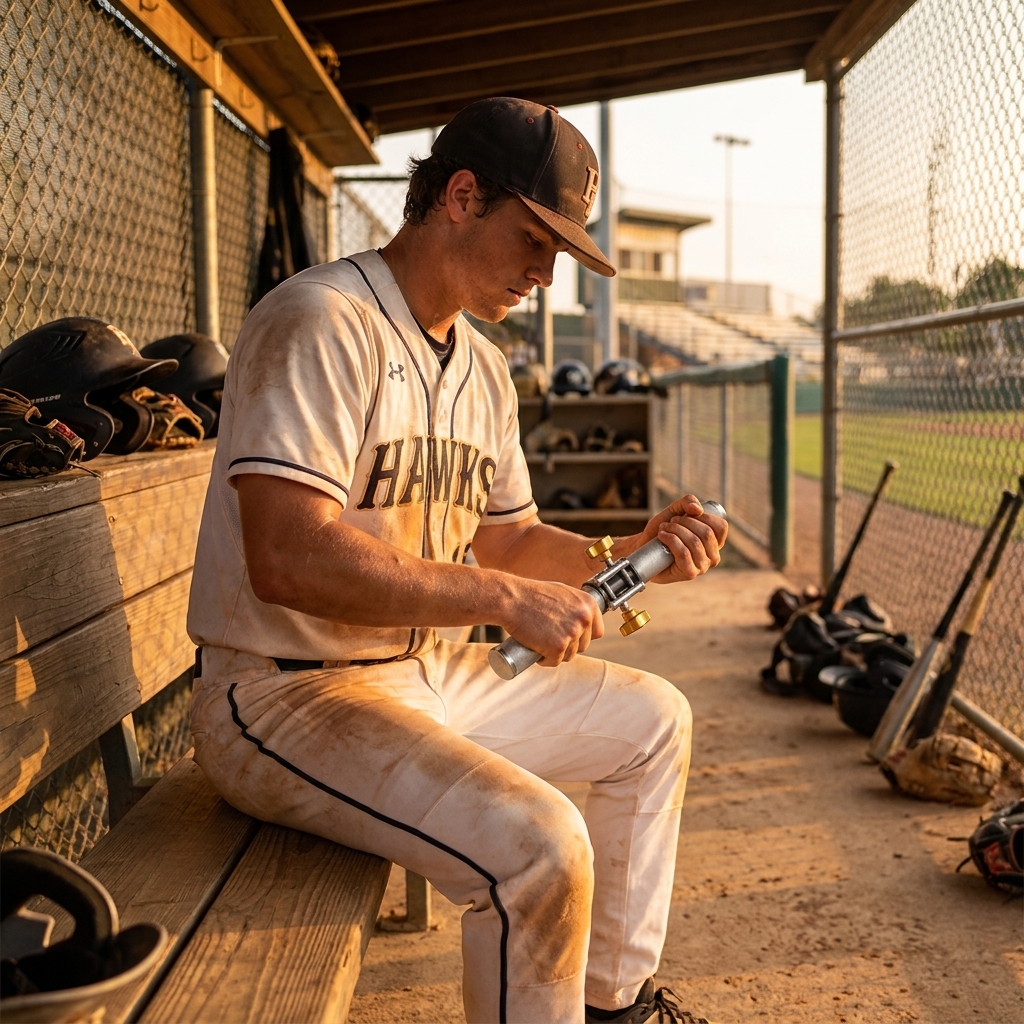
The Dynamo protocol is simple enough to run out of a bat bag and progressive enough to keep delivering results across a full offseason. Here's the exact protocol travel ball players and high school hitters are using to add 5–7 mph to their exit velocity in a single offseason:
The adjustable resistance means the protocol scales from a 13U player starting at Level 2 to a college hitter maxing at Level 9–10. The Dynamo fits in a bat bag and goes wherever the season goes — hotel rooms, dugouts, parking lots before showcases. Ten minutes a day is enough. The results show up on the Trackman gun before they show up anywhere else.