
Your grip is the weakest link in almost every upper body movement.
It gives out before your back does on deadlifts, quits before your shoulders do on pull-ups, and decides matches at the table and on the wall.
The good news is grip responds fast. Most people notice a real difference within four to six weeks.
This guide gives you the exercises, the weekly schedule, and goal-specific grip strength workouts for deadlifts, climbing, arm wrestling, and beginners.
Start where you need to and build from there.
Research consistently links stronger grip to longer life and better heart health. A 2015 study tracking over 140,000 people found grip strength predicted mortality better than blood pressure.
See exactly where yours stands on our average grip strength by age chart.
The Three Types of Grip Strength You Need to Train
 Most people only train one. All three matter.
1. Crush grip
Crush grip is your closing force, the power to squeeze something firmly.
Handshakes, grippers, barbell holds. This is what most people mean when they say grip strength.
2. Pinch grip
Pinch grip is the strength between your thumb and fingers with no bar to wrap around.
Plate pinches, rock climbing edges, carrying awkward objects. Your thumb does most of the work.
3. Support grip
Support grip is holding endurance. How long can you hang? How far can you carry heavy weights before your hands give out?
This is what fails first on long deadlift sets and farmer's walks.
A well-rounded grip strength workout routine hits all three every week, not just crush grip with a hand gripper.
The Best Grip Strength Exercises You Need to Try
Let me give you the exercises to improve grip strength that actually move the needle. No fluff, just what works.
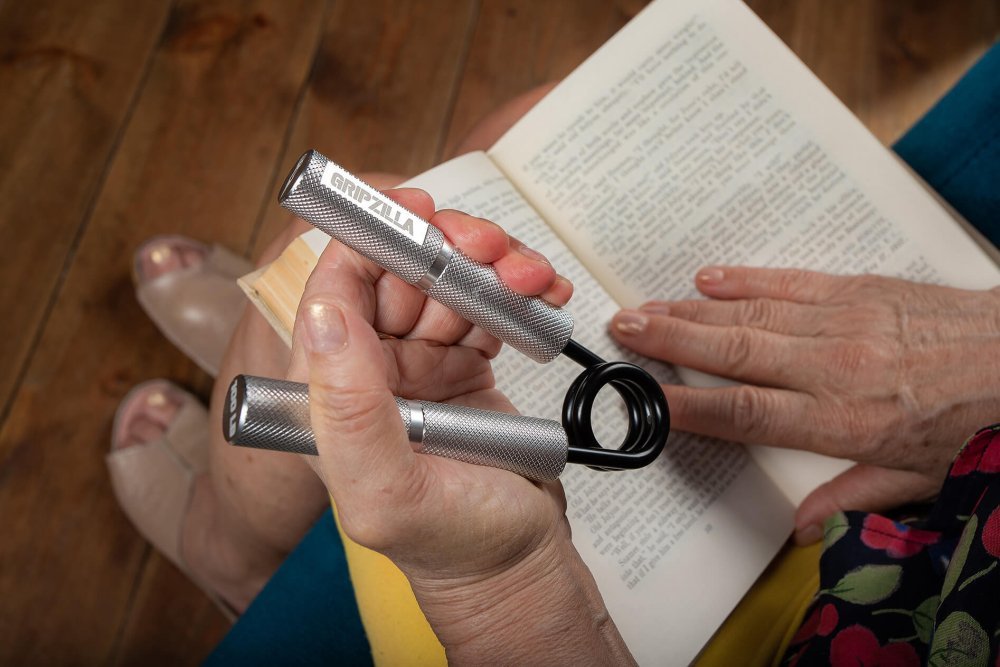
1. Hand Grippers

The most direct way to build crush grip.
- Hold the gripper parallel to your fingers
- Squeeze until the handles touch, hold 1 to 2 seconds
- Release slowly, that lowering phase is where the strength is built
- 3 sets of 8 to 12 reps per hand
The Gripzilla Ultimatum 6-Piece Kit runs from 50 lbs up to 300 lbs and gives you a clear progression path from beginner to advanced in one purchase.
Why it works: Closing force is the most transferable grip quality across sports, daily tasks, and gym lifts. If you only add one tool, make it this.
2. Gripzilla Tornado (The 30-Muscle Activator)

Standard grippers only train one plane of motion.
The Gripzilla Tornado uses friction-based rotational resistance to hit the fingers, palms, wrists, and forearms through every angle in one movement.
- Grip with both hands at different angles
- Twist and rotate against the resistance, horizontal then vertical then diagonal
- 3 sets of 10 to 15 reps each direction
- Increase friction resistance as each angle becomes easy
Why it works: Grip in real life and sport rarely moves in one plane. Rotational training builds the endurance and control that flat crush-grip work misses. This is the tool arm wrestlers and climbers reach for first.
3. Dynamo Wrist Roll (Maximum Forearm Development)
 The Gripzilla Dynamo works through wringing and rolling motions that load all 20 forearm muscles and the wrist stabilisers together.
- Horizontal twisting motion (wringing a towel) for 3 sets of 12 reps
- Vertical rolling motion (revving a motorcycle) for 3 sets of 12 reps
- Use the notched resistance system to progressively overload
Why it works: Wrist stability underlies every grip exercise and every compound lift. Weak wrists cap your grip strength ceiling regardless of how strong your fingers are.
For a full picture on wrist training, see our wrist mobility exercises guide.
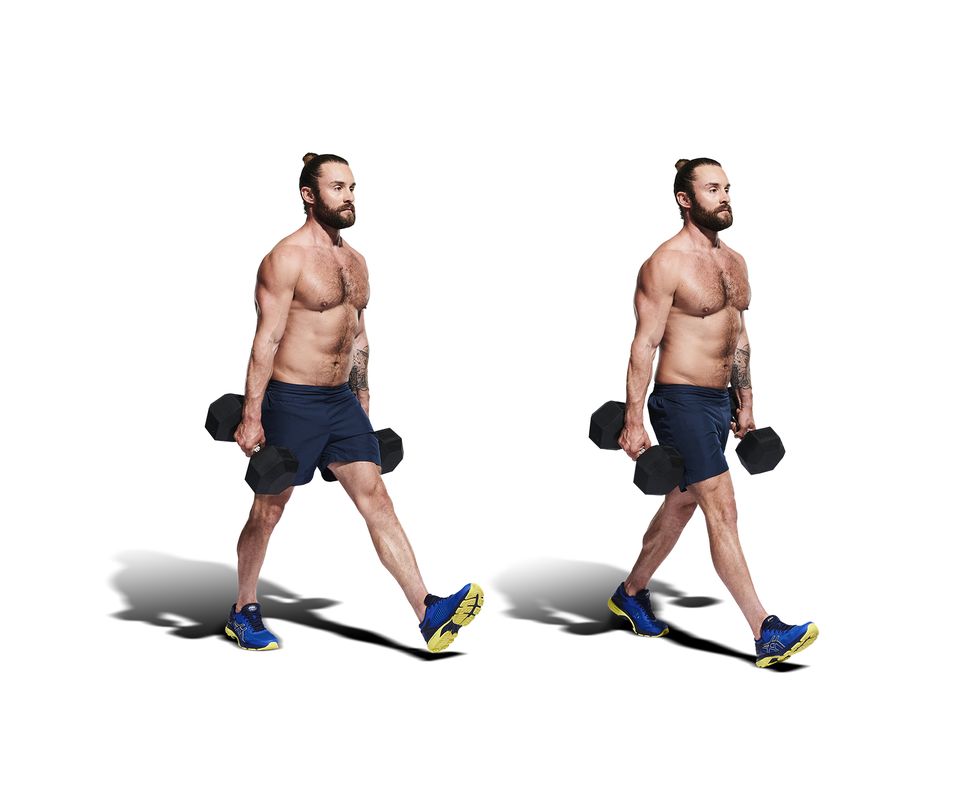
4. Farmer's Walks (The Ultimate Functional Exercise)

Pick up something heavy and walk. Sounds simple. By round three your forearms will tell you otherwise.
- Grab two heavy dumbbells or kettlebells, challenging but not posture-breaking
- Walk 40 to 60 feet or hold for 30 to 60 seconds
- Rest 60 seconds, repeat 3 to 4 rounds
- Add weight when the distance feels manageable
Why it works: Support grip under load plus full-body stabilisation. This is the most functional forearm grip workout available and the one that carries over most directly to carrying, pulling, and real-life tasks.
5. Dead Hangs (Build Serious Holding Power)
 Hang from a pull-up bar with arms fully extended. No swinging, no kipping, just grip fighting gravity.
- Jump up and grip the bar with both hands
- Let your body hang, squeeze through the ring and pinkie fingers specifically
- Start at 20 to 30 seconds, work toward 60 seconds or more
- 3 sets with 60 seconds rest between
Why it works: Builds support grip endurance and decompresses the spine at the same time. We cover every benefit in our dead hang benefits guide.
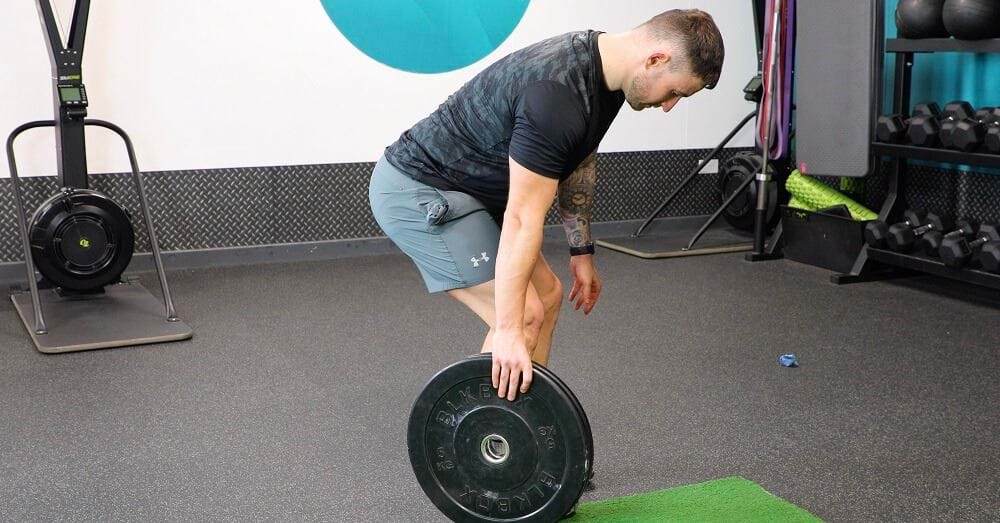
6. Plate Pinches (Train That Thumb)

Your thumb contributes roughly half your total grip force. Most grip training ignores it completely.
- Hold one or two weight plates smooth-side out between thumb and fingers
- Stand straight with arms at sides, hold for 20 to 30 seconds
- 3 to 4 sets per hand
- Start at 5 to 10 lbs, progress to 25 to 45 lbs over weeks
Why it works: Pinch grip transfers to climbing, awkward carries, and any lift where you can't wrap the thumb fully around a bar.
7. Towel Pull-Ups (Next-Level Challenge)

Wrap a towel over a pull-up bar and grip the ends. The unstable, thick grip surface forces your hands to work twice as hard as a standard bar.
- For hangs: grip both ends and hold as long as possible, 3 sets
- For pull-ups: 3 sets of 5 to 8 reps, lowering with control
- Can't do pull-ups? The hang alone builds serious grip endurance
Why it works: Thick grip training transfers to any thicker implement and builds the finger and palm strength that standard bars don't challenge.
For more grip work built for pull-ups see our grip strength for pull-ups guide.
8. Wrist Curls and Reverse Wrist Curls
The foundation exercise that most experienced lifters skip and then wonder why their wrists ache.
- Sit on a bench, forearms resting on thighs, wrists hanging off the edge
- Palms up: curl wrists upward and lower slowly. 3 sets of 15 to 20 reps
- Palms down: same movement for reverse curls, trains the extensors on the back of the forearm
- Keep the weight light, this is a finisher, not a max-effort movement
Why it works: Flexor and extensor balance prevents the imbalances that cause tennis elbow and wrist pain. If your wrists feel smaller or weaker than they should, wrist curls plus the Dynamo is the combination that fixes it.
Simple Grip Strength Workout Routine
Here's a beginner grip workout you can do 2-3 times per week:
Workout A (15-20 minutes):
- Hand grippers: 3 sets x 10 reps each hand
- Farmer's walks: 4 sets x 40 feet
- Dead hangs: 3 sets x 30 seconds
- Wrist curls: 3 sets x 15 reps
Workout B (15-20 minutes):
- Plate pinches: 3 sets x 30 seconds each hand
- Towel pull-ups or hangs: 3 sets x 5 reps (or max hang time)
- Reverse wrist curls: 3 sets x 15 reps
- Hand grippers: 3 sets x 8 reps (heavier resistance)
Workout C - The Gripzilla Power Session (10-15 minutes):
- Gripzilla Tornado: 3 sets x 15 twists each direction
- Dynamo Wrist Roll: 3 sets x 12 horizontal wringing motions
- Dynamo Wrist Roll: 3 sets x 12 vertical rolling motions
- Hand grippers: 2 sets x max reps (finisher)
How to Build Grip Strength Fast
Want faster results? Here are the secrets most people miss:
Train grip at the end of workouts. Your forearm exercises shouldn't interfere with your main lifts. Do them after deadlifts, rows, and pull-ups.
Focus on time under tension. Longer holds build endurance. Heavy squeezes build power. Mix both.
Don't use straps all the time. Lifting straps are helpful for max-effort sets, but overusing them robs you of natural grip strength training. Challenge yourself to go strapless on warm-up sets.
Progressive overload matters. Add time, add reps, or add resistance every few weeks. If you're closing the same 100-pound gripper for months, you're not getting stronger.
Train all three grip types. Don't just focus on crush grip. Mix in pinch and support work to develop well-rounded hand strength.
Grip Training for Specific Goals
For Deadlifts
If grip strength for deadlifts is your main concern, focus on:
- Heavy farmer's walks with short rest periods
- Barbell holds (load up a barbell and just hold it for time)
- Mixed grip or hook grip practice
- Grip Boosters to make your barbell thicker
For Rock Climbing
Climbers need finger strength and pinch grip power. Try:
- Plate pinches with increasing weight
- Finger hangs on a pull-up bar (careful here, start light)
- Dead hangs with varying grip widths
For Arm Wrestling
Arm wrestlers need everything plus insane wrist strength. The Arm Wrestling Essential Kit has cylinder grips, cone grips, and oval grips that train cupping, hook strength, and pronation specifically for the table.
Common Grip Training Mistakes
Here are some grip training mistakes you need to be aware of:
Mistake #1: Training Grip Every Single Day
Your forearms are small muscles and they get beat up easily. How often to train grip? Two to three times per week is plenty. More isn't always better.
- Give your hands 48 hours between intense sessions
- Light grip work (like using grippers while watching TV) is fine daily
- If your forearms are sore, let them recover
Mistake #2: Ignoring the Extensors
Everyone trains the flexors (the muscles that close your hand), but the extensors (the ones that open your hand) need love too.
- Use rubber bands to train finger extensions
- Try a rice bucket for extensor work (stick your hand in, spread fingers against resistance)
- This prevents imbalances and injuries like tennis elbow
- Aim for 2-3 sets of 15-20 reps of extension work per session
Mistake #3: Going Too Heavy Too Fast
Your tendons and ligaments need time to adapt. They strengthen slower than muscles.
- Start lighter than you think you need to
- Add resistance gradually over weeks, not days
- If your wrists or fingers hurt (not just tired), back off immediately
- Smart training beats tough-guy training every single time
Mistake #4: Using Only One Type of Grip Training
Don't just do hand grippers and call it a day.
- Mix crush grip, pinch grip, and support grip exercises
- Include static holds and dynamic movements
- Rotate through different tools and angles
Mistake #5: Skipping Warm-Ups
Cold tendons tear easily. Always warm up before heavy grip work.
- Do 5-10 light squeezes or wrist circles before training
- Start with your easiest gripper or lightest weight
- Gradually work up to your working sets
The Bottom Line
Building powerful grip strength isn't complicated. You need the right tools, consistent training, and a bit of patience.
Start with basic exercises like hand grippers, farmer's walks, and dead hangs. Add variety with wrist curls, plate pinches, and towel work.
Your hands are how you interact with the world. Strong hands mean better workouts, easier daily tasks, and a longer, healthier life. That's not hype. That's science.
Ready to stop making excuses? Grab some proper equipment and start training.
Also, check out the full lineup of grip strength tools at Gripzilla and start building hands that don't quit.
FAQs About Grip Strength Workouts
How often should I do grip strength workouts?
Two to three times per week with 48 hours between sessions. Light tools like gripper rings can be used daily since the resistance is low enough for continuous use.
How long does it take to improve grip strength?
Most people notice easier daily tasks within three to four weeks. Measurable strength gains on a dynamometer or gripper level-up typically come between eight and twelve weeks of consistent training.
Should I train grip on the same day as arms or back?
Yes, at the end of the session. If your forearms are already fatigued from rows and pull-ups, that counts as partial grip training. Finish with one or two isolation grip exercises rather than a full grip session.
What is the best single exercise to improve grip strength?
Farmer's walks for functional carry-over, dead hangs for support endurance, hand grippers for raw crush strength. Pick based on your goal. If you genuinely have no goal yet, start with dead hangs since they also tell you your baseline.
Do grip strength workouts build forearm size?
Yes, particularly the exercises that train wrist flexors and extensors under load. Wrist curls, Dynamo rolling, and farmer's walks all add forearm muscle mass over time.