
Phil Heath's biceps won seven straight Mr. Olympia titles.
Not by being the biggest in the lineup, but by being the roundest, fullest, and most detailed arms anyone had ever brought to the stage.
This is the real breakdown of how he built them: his actual bicep routine, the FST-7 method behind the fullness, his own three training tips, and the honest truth about what happens when a natural lifter tries to copy it.
We coach forearm and grip training for a living at Gripzilla, so the focus here is on what's real and repeatable, not hero worship.
How Big Are Phil Heath's Biceps

Let's settle the number first, since that's half of why you're here.
On camera with Will Tennyson, Heath's biceps measured 21 inches.
In full contest condition his arms sat in the low-to-mid 20-inch range, and what set them apart was never raw size alone.
His bicep and tricep size, forearm thickness, and symmetry made him stand out on stage, with definition so sharp you could see every muscle fiber under paper-thin skin.
For context on the man himself: Phillip Heath, nicknamed "the Gift," is a seven-time Mr. Olympia who won every year from 2011 to 2017, tying Arnold Schwarzenegger's title count.
The arms earned the nickname. If you want to see how he stacks up against other massive arms, our ranking of the biggest biceps in Hollywood puts real inches next to the hype.
The Phil Heath Bicep Workout Routine

Here's how he actually trained biceps. Heath built his arms on controlled tempo, constant tension, and relentless volume, not ego lifting.
A few principles ran through every session:
- He kept rest periods short, sometimes 10 to 15 seconds, to flood the muscle with blood
- He obsessed over the mind-muscle connection, chasing a "perfect rep" feel and then repeating it
- He used submaximal weight he could control through a full range
A representative Phil Heath bicep workout looks like this:
1. Seated alternating dumbbell curls
- 4 sets of 10 to 12 reps
- His go-to opener. Seated kills the cheating, forcing the biceps to do the work
2. Cable cross-body curls
- 3 sets of 12 reps per arm
- Standing side-on to a low pulley, curling across the body to the opposite chest for a hard peak contraction
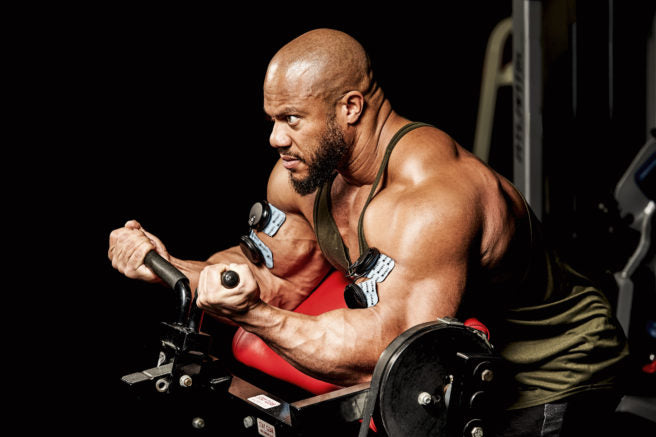
3. Preacher curls with EZ bar
- 3 sets of 10 to 12 reps
- Locks the elbows in place and loads the lower biceps and stretch position
4. Constant-tension machine or dumbbell curls
- 3 to 4 sets of 12 to 15 reps
- Done constant-tension style, never fully bending or extending the arm, which traps blood and produces a skin-splitting pump and deep burn.
Keep rests between working sets in the 45 to 90 second range.
Most of his sets sit in the 8 to 12 hypertrophy zone, with burnout supersets pushing past 20 reps. A full Heath bicep session runs around 40 minutes of focused, high-quality work.
For a different take on building serious mass, the high-volume Lee Priest arm workout runs 20-plus sets per session, while the Arnold Schwarzenegger arm workout shows how the old-school greats trained the same muscle.
What Is FST-7 and Why It Built Phil Heath's Biceps

This is the part most articles skip, and it's the actual reason his arms looked the way they did.
Heath was coached by Hany Rambod, a 25-time Olympia-winning trainer, using his FST-7 system, short for Fascia Stretch Training. The idea is mechanical.
Rambod's theory is that some lifters have thick, rigid fascia that restricts muscle growth like a balloon inflating inside a box, and that flooding the muscle with blood stretches that connective tissue casing from the inside out, creating room to grow.
In practice, FST-7 is simple to describe and brutal to execute. You finish a session with seven sets of an isolation exercise, taking only 30 to 45 seconds of rest between them, to force maximum blood into the muscle.
For biceps, that means seven back-to-back sets of curls at the end of your workout, chasing the biggest pump of your life.
A few rules make or break it:
- Use an isolation move, never a heavy compound
- Pick a weight where set one lands around 10 to 12 reps, not 8, not 15
- Keep a timer running and actually respect the 30 to 45 second rest
- Small muscles like biceps can handle FST-7 up to twice per week
This is the engine behind the fullness. If you take one thing from how Heath trained, take this.
Phil Heath's Three Bicep Tips
Heath has shared his own framework for growing biceps, and it's refreshingly free of gimmicks. His advice comes down to three things:
1. Nail your volume and frequency so the muscle gets consistent work
2. Train all three regions of the arm, the short head, long head, and brachialis, to trigger full growth, and use slow negatives.
3. That last one is the underrated cue. Performing slow negatives lets the biceps stretch and lengthen while keeping constant tension on the muscle.
Can a Natural Lifter Build Biceps Like Phil Heath
Here's the honest answer, because you deserve one before you copy a pro's program.
The short version: use his principles, not his volume. A real-world test makes the case clearly.
When a natural lifter ran a combined Phil Heath arm routine once a week for six weeks, his arms grew just over half an inch, and the post-workout fatigue was so severe that his chest, back, and shoulder sessions suffered, costing him muscle elsewhere.
The reason is not effort. Pros like Heath use performance-enhancing drugs that dramatically improve recovery, letting them train longer and harder and bounce back from volume that would bury a natural lifter.
Sixteen sets of biceps in one session is a recovery load most naturals simply cannot absorb.
What actually transfers to a natural lifter:
- The FST-7 finisher, used once on biceps at the end of your normal arm day
- The Three T's, technique, tension, and time over heavy ego lifting
- Slow negatives and constant tension on every set
- Training all three arm regions, not just standard curls
Run those principles inside a sane volume and you get the benefit without the burnout. Borrow the method, scale the dose.
The same enhanced-versus-natural reality runs through the Rich Piana arm workout, another pro routine worth scaling rather than copying rep for rep.
Don't Let Your Grip Cap Your Curls
 One practical thing the pro routines gloss over.
On high-rep FST-7 curl sets, your grip and forearms often fatigue before your biceps are finished, which quietly caps the exact volume that drives growth.
Heath himself was known for forearm thickness and symmetry, not just biceps, because complete arms need the whole package.
Building grip and forearm strength fixes both the bottleneck and the look:
- The Gripzilla Dynamo trains wrist flexors and extensors through a wringing motion, building the forearm thickness that finishes the arm. Browse the Dynamo collection for resistance options.
- The Gripzilla Tornado hits rotational and grip strength that standard curls never reach, adding mass around the entire forearm.
- When your grip gives out before your biceps on long sets, progressive hand grippers build the crushing strength to finish every rep.
For a deeper menu of accessory work, our guide to forearm strength exercises pairs well with any bicep program, and if you want a pro who treats forearms as a priority, the Sam Sulek forearm workout is built entirely around them.
Phil Heath Biceps FAQ
How big are Phil Heath's biceps?
Measured at 21 inches on camera, sitting in the low-to-mid 20-inch range in full contest condition, with the definition and fullness that made them stand out.
How did Phil Heath build his biceps?
Controlled high-volume training under coach Hany Rambod, built around the FST-7 method and his "Three T's" of technique, tension, and time.
What is FST-7?
Fascia Stretch Training. Seven sets of an isolation exercise with 30 to 45 seconds of rest as a session finisher, flooding the muscle with blood to stretch the fascia and create room for growth.
How many sets did Phil Heath do for biceps?
His dedicated arm session ran around 16 sets for biceps, a volume suited to an elite enhanced athlete, not a typical natural lifter.
Can a natural lifter use Phil Heath's bicep routine?
The principles yes, the full volume no. Borrow the FST-7 finisher, slow negatives, and constant tension, but scale the total sets to something you can recover from.