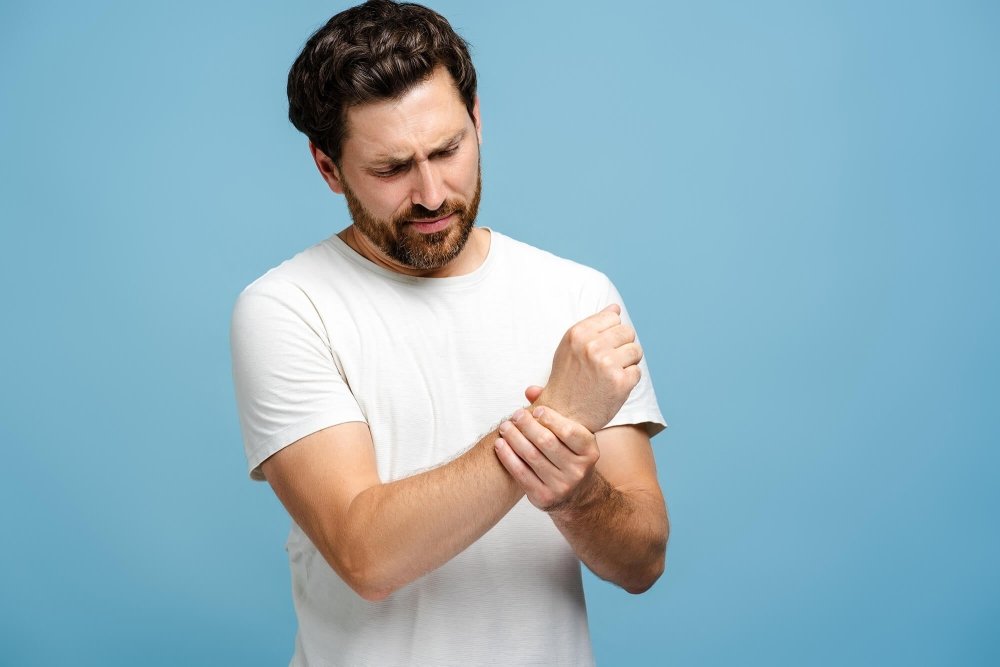

You hit the gym, ready to crush your set. You grab the barbell, start your curls, and then, ouch. That sudden sting in your forearm ruins your flow.
Forearm pain when lifting is something almost every lifter runs into at some point.
It’s frustrating, right? You’re trying to build muscle, not deal with random aches.
So, let’s talk about why your forearm hurts when lifting, what’s actually causing it, and how you can fix it without taking weeks off the gym.
Why Does My Forearm Hurt When Lifting Weights?
Your forearms do a ton of work in the gym, even when you’re not training them directly.
Every time you grip a bar, pull, curl, or press, your forearm muscles and tendons are firing to stabilize and support your movement.
So, when you start feeling pain in your forearm while lifting, it’s usually because those small muscles or tendons are getting overworked.
Sometimes, you’ll feel inner forearm pain when lifting, especially during curls or deadlifts. That usually points to overuse in your flexor muscles.
Other times, it’s outer forearm pain when lifting, which tends to happen when the extensor tendons near your elbow are inflamed or tight.
Either way, it’s your forearm saying, “Hey, ease up a bit.”
Common Causes of Forearm Pain When Lifting

Here are some causes that are worth discussing:
1. Forearm Muscle Strain
The most straightforward cause. When you overload your forearm muscles faster than they can adapt, either by adding weight too quickly or training too frequently, small muscle fibers tear.
This creates a dull, persistent ache that lingers after your session and flares up during gripping or pulling movements like curls, rows, and deadlifts.
Fix: Reduce training volume by 30–40% for 1–2 weeks. Prioritize progressive overload, don't jump weight until your current load feels fully controlled.
2. Lateral Epicondylitis (Tennis Elbow)
Despite the name, tennis elbow is extremely common in lifters. It causes pain and tenderness on the outer forearm, typically just below the elbow.
It develops when the extensor tendons, responsible for bending your wrist backward, become irritated from repetitive overuse.
You'll feel it most during: wrist extension movements, reverse curls, rows, and any pulling exercises.
Fix: Rest the aggravating movement, apply ice for 15 minutes after training, and begin eccentric wrist extensor exercises (slow, controlled lowering movements) as the pain subsides.
3. Medial Epicondylitis (Golfer's Elbow)
The inner-forearm counterpart to tennis elbow. Golfer's elbow affects the flexor tendons on the inside of your elbow and upper forearm.
Lifters get this from heavy bicep curls, chin-ups, and grip-heavy deadlifts, especially with a double underhand grip.
Key symptom: pain or tenderness on the bony bump on the inside of your elbow, which radiates down the inner forearm.
Fix: Avoid wrist flexion under load. Switch grip style temporarily. Eccentric flexor strengthening exercises help once acute pain is under control.
4. Brachioradialis Tendonitis
The brachioradialis is a thick forearm muscle that runs along the outer forearm from your elbow to your wrist.
When it becomes inflamed from repetitive gripping and elbow flexion, it causes a nagging ache along the top of the forearm, often mistaken for a bone issue.
Triggers: hammer curls, reverse curls, pull-ups, any high-rep grip work.
Fix: Temporarily avoid hammer and reverse curl variations. Use a foam roller or massage ball along the forearm to reduce tension in the muscle belly.
5. Poor Form and Wrist Position
This one is often overlooked. Lifting with bent wrists, especially during barbell curls or pressing movements, forces your forearm tendons to work at a mechanical disadvantage.
Over time, that creates chronic low-grade inflammation between the wrist and elbow.
Fix: Keep wrists neutral (straight) throughout your lifts. For exercises like barbell curls where wrist position tends to break down under heavier loads, drop the weight until you can maintain clean form throughout the full range.
6. Weak Grip Relative to Your Training Load
If your grip strength hasn't kept pace with your overall strength, your forearms absorb compensatory stress on every pull and hold.
The muscles fatigue faster, tendons are overloaded, and pain develops, often mid-set or toward the end of workouts.
Fix: Build grip strength as a dedicated training component, not an afterthought. Farmer's carries, dead hangs, and grip trainers help develop the foundational strength that supports all your other lifts.
How to Fix Forearm Pain When Lifting
 Alright, here’s the part that actually helps. You don’t need to stop training forever—you just need to train smarter.
1. Stretch Before and After Lifting
Tight forearm muscles are often the main culprit. Try a simple forearm stretch: extend your arm straight, pull your fingers back gently with the other hand, and hold for 20 seconds.
Then switch. Do this before and after your workout.
2. Warm Up Smart
Before you grab the heavy weights, do a quick forearm warm-up. Try wrist circles, light band stretches, or a few sets with lighter weights.
A solid warm-up keeps your muscles loose and ready to work.
3. Strengthen Your Grip
If your grip gives out before your muscles do, your forearms will always suffer. Use grip trainers, hand grippers, or do farmer’s carries to build grip strength.
Gym Movements That Commonly Trigger Forearm Pain
Not all exercises hit your forearms equally. Some lifts just load them up more than others.
If you’re struggling with forearm pain from lifting weights, pay attention during these moves:
- Bicep curls (especially with straight bars)
- Deadlifts (heavy ones with mixed grip)
- Pull-ups or chin-ups
- Farmer’s carries
- Rows (barbell or dumbbell)
These exercises all demand strong grip and forearm stability. If your forearms aren’t ready, they’ll start to ache fast.
Try switching to neutral grips, using straps occasionally, or adjusting your form to reduce strain.
How to Prevent Forearm Pain When Lifting Weights
You can avoid this problem completely by building good habits.
- Warm up your wrists and forearms before every session.
- Use proper form and grip position.
- Progress slowly. Don’t overload your muscles too quickly.
- Include grip training in your weekly routine.
- Stretch your forearms after your workout.
These simple habits go a long way in preventing forearm tendonitis from lifting and keeping you pain-free.
Quick Recovery Exercises for Sore Forearms
 If your forearms are already sore or tight, these quick moves can help ease the tension:
- Wrist Flexor Stretch: Arm straight, palm up. Pull your fingers back gently.
- Wrist Extensor Stretch: Palm down this time, and pull your hand toward you.
- Forearm Massage: Use a massage ball or foam roller to loosen up the muscles.
- Towel Twist: Twist a towel like you’re wringing it out. Go both directions.
- Reverse Curls: Use light dumbbells to target your outer forearm and balance strength.
These moves improve blood flow and help your forearms recover faster.
When to See a Professional
Most forearm pain from lifting goes away with rest, stretching, and smart lifting.
But if your pain lasts more than a couple of weeks or your grip starts feeling weak, it’s time to check in with a doctor or physiotherapist.
You might have forearm tendonitis or a small strain that needs guided rehab.
Don’t ignore it. The longer you wait, the worse it gets, and the more time you’ll spend out of the gym.
Keep Lifting Smart, Not Painful
Forearm pain when lifting doesn’t mean you’re broken. It means your body’s sending you a message: fix your form, improve your grip, and give your muscles some love.
Once you take care of the pain and strengthen your grip, every lift, from curls to deadlifts, will feel smoother and stronger.