
The best arm exercises train all three muscle groups in your arm: biceps, triceps and forearms.
The most effective are close-grip bench press, barbell curls, overhead triceps extensions, hammer curls and farmer's carries, run across two sessions a week with 14 to 20 total sets per muscle group.
Most people train one third of their arm and blame genetics for the result. Your triceps make up roughly two thirds of your upper arm mass.
Your forearms are visible in every short sleeve you own. Yet the average arm day is curls, more curls, and a couple of pushdowns at the end.
Here are the 15 exercises worth your time, with sets, reps and programming for each.
Arm Anatomy (The Muscles Your Arm Workout Needs to Hit)
Understanding what you are training changes how you train it.
Biceps brachii
Front of the upper arm, two heads. Bends the elbow and rotates the forearm palm-up.
The long head sits on the outside and creates the peak, and it is most stimulated when your arm is extended behind your torso. That is why incline curls belong in your program.
Brachialis
Sits underneath the biceps. It generates around 50% more force than the biceps and pushes the biceps upward as it grows, adding visible thickness from the front and the side.
Trained with neutral and overhand grips, which is why hammer curls matter more than most people think.
Triceps brachii
Back of the upper arm, three heads, roughly two thirds of your total upper arm mass.
The long head alone accounts for around 55% of the triceps and only reaches full stretch when your arm is overhead. Skip overhead work and you are leaving the majority of your arm size untrained.
Forearms
Brachioradialis plus the flexor and extensor groups. They control your wrist, fingers and grip strength, which caps every pulling movement you do. Weak forearms mean your hands fail before your back does.
Best Bicep Exercises for Mass
Here are the top few of them:
1. Barbell Curl
 The heaviest biceps loading available, since both arms work a single implement together.
- Hits: Both biceps heads, maximum overall load.
- How: Feet hip-width, underhand grip at shoulder width, elbows tucked. Curl to shoulder height, squeeze, lower under control.
- Sets and reps: 4 x 8 to 10, resting 90 seconds.
- Common mistake: Elbows drifting forward and the lower back arching. Both mean the weight is too heavy.
- Progression: Beginners use an EZ-bar to spare the wrists. Advanced lifters add a three-second lowering phase.
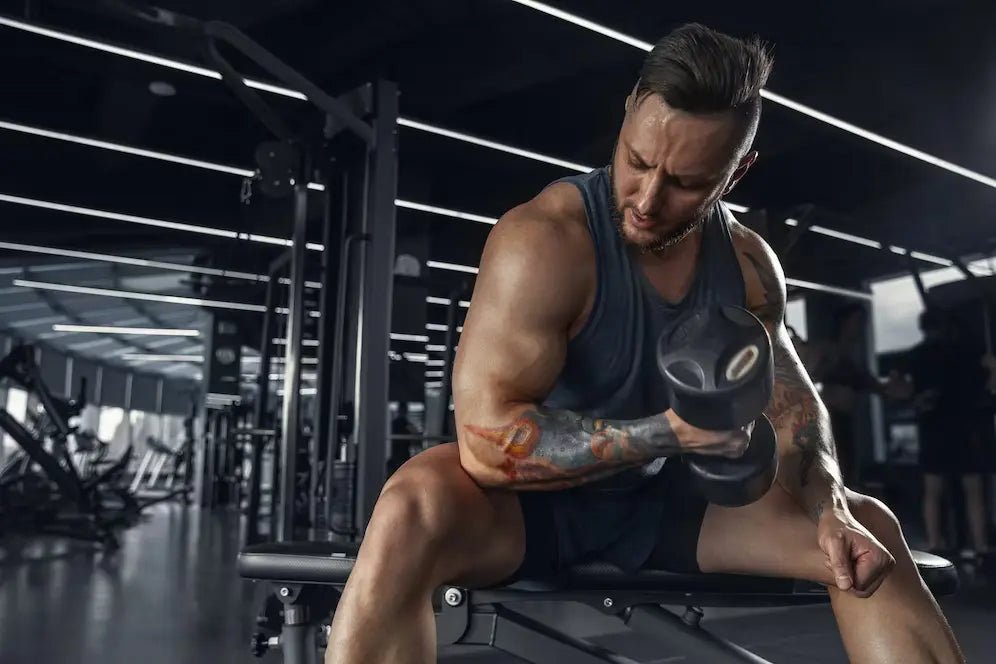
2. Incline Dumbbell Curl
 Puts the long head under stretch before the rep begins, which is where the growth stimulus is highest.
- Hits: Long head of the biceps, responsible for the peak.
- How: Bench at 45 degrees, arms hanging straight down, curl without letting your shoulders roll forward.
- Sets and reps: 3 x 10 to 12.
- Common mistake: Shrugging the shoulders forward at the top, which removes the stretch that makes this exercise work.
- Progression: Start with a shallower incline if the stretch is uncomfortable, then work toward 45 degrees.
3. Hammer Curl

The most underrated exercise on this list. The neutral grip shifts load onto the brachialis and brachioradialis.
- Hits: Brachialis, brachioradialis, biceps.
- How: Dumbbells at your sides, palms facing each other. Curl without rotating the wrist.
- Sets and reps: 3 x 10 to 12.
- Common mistake: Swinging from the hips. If your torso moves, drop the weight.
- Why it matters: Brachialis growth is what makes an arm look thick rather than just long.
4. EZ-Bar Preacher Curl

The pad eliminates momentum entirely, so the biceps do all the work.
- Hits: Biceps, particularly the lower portion near the elbow.
- How: Arms flat on the angled pad, underhand grip. Curl up, pause, lower until arms are nearly straight.
- Sets and reps: 3 x 10 to 12.
- Common mistake: Bouncing out of the bottom. The stretched position is where tension peaks and where injuries happen.
5. Cable Curl

Constant tension at every point in the range, including the top where free weights go slack.
- Hits: Both biceps heads.
- How: Low pulley, elbows pinned to your sides, curl and squeeze hard.
- Sets and reps: 3 x 12 to 15.
- Best used: As a finisher, when you want volume without heavy joint stress.
If your biceps have stopped responding, the problem is usually programming rather than exercise choice.
We covered the common causes in why your biceps are not growing, and the best bicep exercises for mass goes deeper on biceps specifically.
Best Tricep Exercises for Bigger Arms
Below are triceps specific arm workouts:
6. Close-Grip Bench Press
 The heaviest triceps exercise available. If you only do one, do this.
- Hits: All three heads, plus chest and shoulders.
- How: Grip just inside shoulder width, elbows at roughly 45 degrees. Lower to the lower chest, press up.
- Sets and reps: 4 x 6 to 8, resting two minutes.
- Common mistake: Gripping narrower than shoulder width. It punishes your wrists without adding triceps stimulus.
7. Overhead Triceps Extension

The long head is 55% of your triceps and only fully stretches overhead. This is the exercise that reaches it.
- Hits: Long head, maximum stretch position.
- How: Single dumbbell held with both hands, or a rope on a high cable. Lower behind your head, extend fully.
- Sets and reps: 3 x 10 to 12.
- Common mistake: Elbows flaring out to the sides. Keep them pointed forward.
- Why it matters: Most arm programs contain no overhead triceps work at all. Adding one movement here is the single fastest fix for arms that will not grow.
8. Skull Crusher
 The best long-head builder you can do lying down.
- Hits: Long head under stretch.
- How: EZ-bar over your chest, lower to your forehead or just behind it, bending only at the elbows.
- Sets and reps: 3 x 10 to 12.
- Progression: Lowering behind your head instead of to your forehead increases the stretch and the stimulus.
9. Triceps Dip
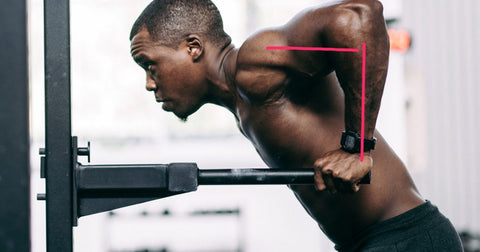
Bodyweight, scalable, and brutal once you add load.
- Hits: All three heads plus chest and front delts.
- How: Parallel bars, torso upright, elbows tucked. Lower until upper arms are parallel to the floor.
- Sets and reps: 3 sets stopping two reps short of failure.
- Common mistake: Leaning forward, which shifts the work to the chest. Stay vertical.
10. Cable Pushdown
 Constant tension, high reps, minimal joint stress.
- Hits: Lateral and medial heads.
- How: High pulley, elbows locked at your sides. Push down, spread the rope at the bottom, control the return.
- Sets and reps: 3 x 12 to 15.
- Common mistake: Moving the elbows. If they travel, your lats are doing the work.
Triceps that refuse to grow almost always come down to neglecting the long head.
More in why your triceps are not growing, and at-home tricep workouts covers the equipment-free versions.
Best Forearm and Grip Exercises
This is where most arm training falls apart. Forearms are visible constantly, and grip strength caps every pulling movement in the gym.
11. Reverse Curl
 The most direct forearm builder that still trains the upper arm.
- Hits: Brachioradialis, wrist extensors, brachialis.
- How: Overhand grip on an EZ-bar, wrists locked straight throughout.
- Sets and reps: 3 x 12 to 15.
- Common mistake: Using curl weight. Expect to drop 30 to 40% versus a standard curl.
12. Farmer's Carry
 The single best builder of support grip, meaning your ability to hold heavy things for time.
- Hits: Forearms, grip, traps, core.
- How: Heavy dumbbells or a trap bar, walk for distance with shoulders back.
- Sets and reps: 3 to 4 carries of 30 to 40 metres.
- Cue: Load it heavy enough that your grip fails before your legs do.
13. Wrist Roller Work
 Continuous tension through the full forearm, training flexors and extensors together.
- Hits: Wrist flexors, extensors, rotational strength.
- How: Roll a weighted line up, then control it back down. Both directions matter equally.
- Sets and reps: 3 sets, up and down twice per set.
- Equipment note: A dedicated tool like the Dynamo keeps the forearm loaded through the entire wringing motion rather than the brief loading a barbell provides, and it hits both sides of the forearm in one set. For rotational loading as well as flexion, the multi-axis Tornado covers angles a straight roller cannot reach.
14. Hand Gripper Training
 The most direct crush grip exercise, and the easiest to stay consistent with.
- Hits: Forearm flexors, crush grip strength.
- How: Squeeze until the handles touch, hold briefly, release under control.
- Sets and reps: 3 x 8 to 12 per hand heavy, plus one set of 15 to 20 light to finish.
- Common mistake: Half reps. A rep only counts when the handles touch. A graduated gripper set matters here because one fixed resistance stops producing results within weeks.
15. Dead Hang
 Free, simple, and one of the fastest routes to grip endurance.
- Hits: Support grip, forearms, shoulders.
- How: Full overhand grip on a pull-up bar. No straps.
- Sets and reps: 3 hangs to near-failure, tracking time each session.
- Cue: Straps are why your grip never catches up to your back.
For more depth, the best forearm exercises for mass expands on forearm-specific training and grip strength exercises at home covers the no-equipment options.
A Complete Bicep and Tricep Workout
Run this twice a week with at least two days between sessions.
- Close-Grip Bench Press — 4 x 6 to 8
- Barbell Curl — 4 x 8 to 10
- Overhead Triceps Extension — 3 x 10 to 12
- Incline Dumbbell Curl — 3 x 10 to 12
- Cable Pushdown — 3 x 12 to 15
- Hammer Curl — 3 x 10 to 12
- Farmer's Carry — 3 carries of 30 metres
- Hand Gripper — 3 x 10 per hand
Around 45 minutes. The order matters: heavy compound triceps first because they are the largest muscle and deserve your freshest effort, then heavy biceps, then stretch-position isolation, then brachialis, then forearms last so your grip is not compromised for everything above it.
Arm Exercises With Dumbbells You Can Do at Home
No gym required. These six cover all three muscle groups.
- Dumbbell Curl — 3 x 10 to 12
- Hammer Curl — 3 x 10 to 12
- Overhead Dumbbell Extension — 3 x 10 to 12
- Dumbbell Kickback — 3 x 12 to 15
- Diamond Push-Up — 3 sets to near-failure
- Reverse Curl — 3 x 12 to 15
For dumbbell weight, beginners should use roughly 5 to 10% of bodyweight per hand and stay in the 8 to 12 rep range while form is being learned.
A practical starting point is a 12 to 20 pound pair for men and a 5 to 15 pound pair for women, moving up as the top of the rep range gets comfortable. Rest 60 to 90 seconds between sets.
If you have no weights at all, arm exercises without weights covers the bodyweight-only versions, and bigger arm push-ups breaks down the push-up variations that build triceps.
How Much Volume Your Arms Actually Need
Aim for 14 to 20 total weekly sets for biceps and 14 to 20 for triceps, spread across two sessions.
That number includes indirect work. Every pulling exercise hits your biceps and every pressing exercise hits your triceps, so if you are already doing rows and bench, your direct arm work should account for that rather than adding on top of it blindly.
The mistake most people make is imbalance rather than insufficient volume.
Twenty weekly sets of curls against six sets of pushdowns is programming directly against your own goal, given that triceps are the larger muscle.
How to Progress and Break Plateaus
Escalate in this order:
- Add reps until you beat the top of your range comfortably on every set.
- Add weight and drop back to the bottom of the range.
- Slow the lowering phase to three or four seconds.
- Add a set, only after the above have run out.
Track it. Sets, reps and weight, logged every session. If you are running the same 3 x 10 with the same dumbbells you used six months ago, your arms stopped growing six months ago.
Measure your arm circumference cold, not flexed, every four weeks. It is a slower but far more honest signal than the mirror.
Best Arm Exercises FAQs
What are the best arm exercises overall?
Close-grip bench press for triceps, barbell curls for biceps, and farmer's carries for forearms. Those three cover the most muscle under the heaviest load.
How often should you train arms?
Twice a week for most people. Arms also get significant indirect work from pressing and pulling, so more frequency usually costs recovery without adding growth.
Should you train biceps or triceps first?
Triceps. They are roughly two thirds of your upper arm, so they earn your freshest effort.
Can you build arms at home?
Yes. Dumbbell curls, hammer curls, overhead extensions, diamond push-ups, dead hangs and hand grippers cover all three muscle groups without a gym.
How long until you see results?
Four to six weeks of consistent training with adequate protein for visible change. Strength improves noticeably faster than size.
Are forearm exercises necessary?
If you want arms that look complete and a grip that does not fail before your back does, yes. Forearms are the most visible arm muscle in everyday clothing.
Do arm exercises differ for men and women?
No. The exercises, form and progression are identical. Only the loading differs, and that is down to individual strength rather than gender.
Start Training All Three
Biceps, triceps, forearms. Train one and blame genetics, or train all three and watch what happens.
Weak hands have no place here. Build the grip that holds up everything else.