
Arm wrestling looks simple. Two people, one table, and pure strength.
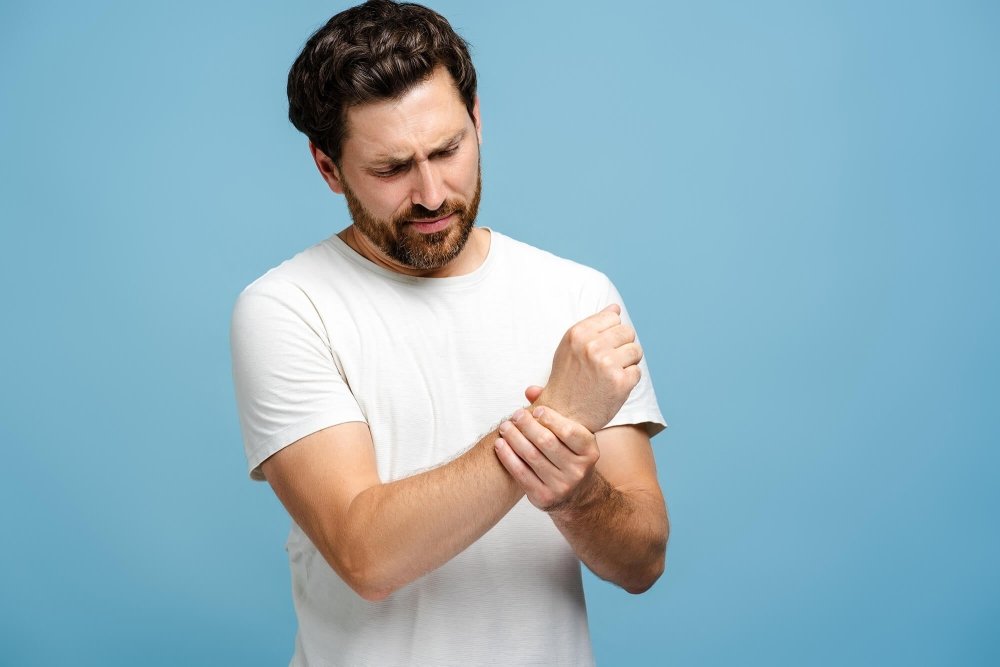
But anyone who has felt that sudden pop or seen someone’s arm snap knows how serious it can get.
Let’s talk about how to avoid arm break in arm wrestling, what causes it, and what you can do to protect yourself while still enjoying the sport.
Why Arms Break in Arm Wrestling (And What's Actually Snapping)

The bone that breaks is the humerus, your upper arm bone. It doesn't snap from too much force going downward.
It snaps from torsion: a twisting force that builds when your shoulder rotates inward while your hand is locked in place.
Three forces combine to cause the fracture:
1. Torsion: Your shoulder turns inward while your hand stays gripped. This is the primary killer. It builds fast when you're losing and instinctively twist your body to compensate.
2. Valgus bending: Your elbow drifts outside your shoulder line, creating a sideways bending load on the bone. This is the "open arm" position most casual pullers fall into.
3. Compression: Both competitors driving downward while the arm is already under torsion and valgus stress. This is what tips it from dangerous to catastrophic.
A peer-reviewed systematic review of 153 arm wrestling fracture patients found that 82% were males aged 15 to 34, and nearly every single fracture happened in a recreational match, not in competition.
The people getting hurt aren't reckless. They just don't know what position they're in when the bone goes.
How to Not Break Your Arm in an Arm Wrestle (6 Rules)
 Here’s how to avoid arm break in arm wrestling matches:
1. Keep your elbow inside your shoulder line
Your elbow should never drift outside your shoulder. The moment it does, you've lost structural integrity and you're loading the humerus sideways.
Keep your elbow pulled in toward your body throughout the entire match.
2. Your shoulder stays behind your hand, always
Pull your shoulder back and keep it behind your gripping hand. If your shoulder creeps forward and across, your arm begins to rotate into the danger zone. This is the most common mistake in losing positions.
3. Never twist your torso
When you're being beaten, your body wants to rotate. It's trying to generate more force. Resist it.
Twisting your torso while your arm is locked is how the torsional force multiplies fast enough to spiral the bone.
4. Eyes on your hand
If you're looking away from your hand, your body is probably twisting in that direction too. Keep your eyes locked on your gripping hand for the entire match.
It's a simple physical cue that keeps you honest about your position.
5. Tap before your form breaks down
No match is worth a broken arm. If you feel your elbow drifting, your shoulder rotating, or your form collapsing, tap.
This is the rule professional pullers live by, and it's the reason competitive arm wrestling has far fewer fractures than backyard matches. Ego is the leading cause of arm wrestling injuries.
6. Never pull from a cold start
Warm up before any serious match. Light wrist rotations, forearm stretches, and a few resistance band curls prepare your muscles and connective tissue for the torque demands of a match.
A cold humerus under sudden torsional load is far more likely to fracture than one that's warm and primed.
Proper Arm Wrestling Form & Posture
A correct stance is the secret behind arm wrestling injury prevention. The safe arm wrestling posture keeps your bones and muscles working together.
Sit or stand square to the table, plant your feet firmly, and pull your elbow toward your body.
The correct arm position in arm wrestling means your forearm stays vertical, your wrist stays firm, and your shoulder stays close.
This alignment allows the force to flow through your body instead of twisting your arm bones.
How To Arm Wrestle Safely As A Beginner
Beginners often make the arm wrestling mistake of relying purely on brute strength.
Learning how to arm wrestle safely means building a foundation first. Start with correct grip, body alignment, and technique.
But a critical part of that foundation is training your grip, forearm, and wrist stability, because if those fail under stress, your larger joints and bones take the hit.
One excellent tool to include in your training is the Gripzilla Armwrestling Essential Kit.
 This kit gives you a structured system to practice real-match motions, like side pressure, back pressure, pronation, supination, and holding static angles.
It’s engineered with multiple handles and a 6-hole steel base frame so you can replicate the exact force vectors that arm wrestlers experience.
Using it consistently will help your smaller muscles and connective tissues adapt safely to match loads, reducing your risk of injury.
Exercises To Prevent Arm Injury In Arm Wrestling
 Training plays a major role in how to avoid humerus fracture during arm wrestling.
Focus on forearm strengthening exercises, wrist exercises, and grip strength training for arm wrestling.
Having genuine arm wrestling tools is always a plus.
Wrist curls, hammer curls, towel twists, and gripper work build stability in your joints and muscles.
Balancing both sides of your body with muscle balance for arm wrestling helps reduce uneven pressure on your bones.
That’s the foundation of long-term arm wrestling training safety.
Signs Of Arm Injury During Arm Wrestling
It’s critical to know the signs of arm injury during arm wrestling so you can stop before it’s too late.
- Sudden pain or a pop sound in the upper arm
- Numbness or tingling in your hand
- Swelling around the elbow or shoulder
If any of these happen, get medical attention immediately.
The recovery tips after arm wrestling injury include rest, ice, compression, and gradual rehab under a doctor’s supervision. Don’t rush back to the table too soon.
Arm Wrestling Arm Break (Your Most Common Questions Answered)
How common is actually breaking your arm arm wrestling?
More common than people expect. One controlled-event study estimated around 0.5% of competitive matches end in fracture, and casual matches, where there's no coaching, no referees, and no technique standards, are estimated to be multiples higher.
Is the right or left arm more at risk?
Right arm, significantly. In clinical reviews of arm wrestling fractures, around 65% involved the right arm. The dominant arm tends to be used in more mismatched matchups, and people push harder with it.
Does being stronger protect you from breaking your arm?
Partially. Stronger connective tissue and denser bone absorb more torsion before failing. But strength training without technique correction can make things worse. A stronger puller generates more force, which means more torsional load if their position is wrong. Technique first, strength second.
Is it safe to arm wrestle after a fracture?
Only after full medical clearance and proper rehab. Humeral shaft fractures require rigid fixation and a phased recovery. Returning too early risks re-fracture in the same weakened bone. Get imaging confirmation of full healing before pulling again.
What should I do if I feel a pop or sharp pain mid-match?
Stop immediately. Do not try to push through it. Immobilize the arm, avoid rotating it, and get medical attention. A spiral fracture left untreated or aggravated can cause nerve damage on top of the fracture itself.