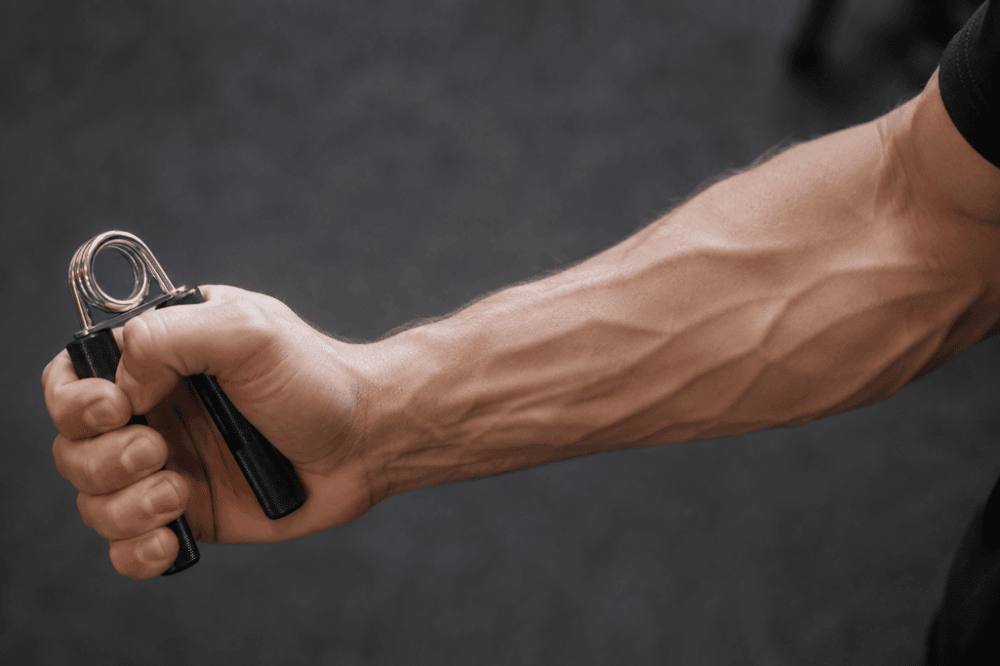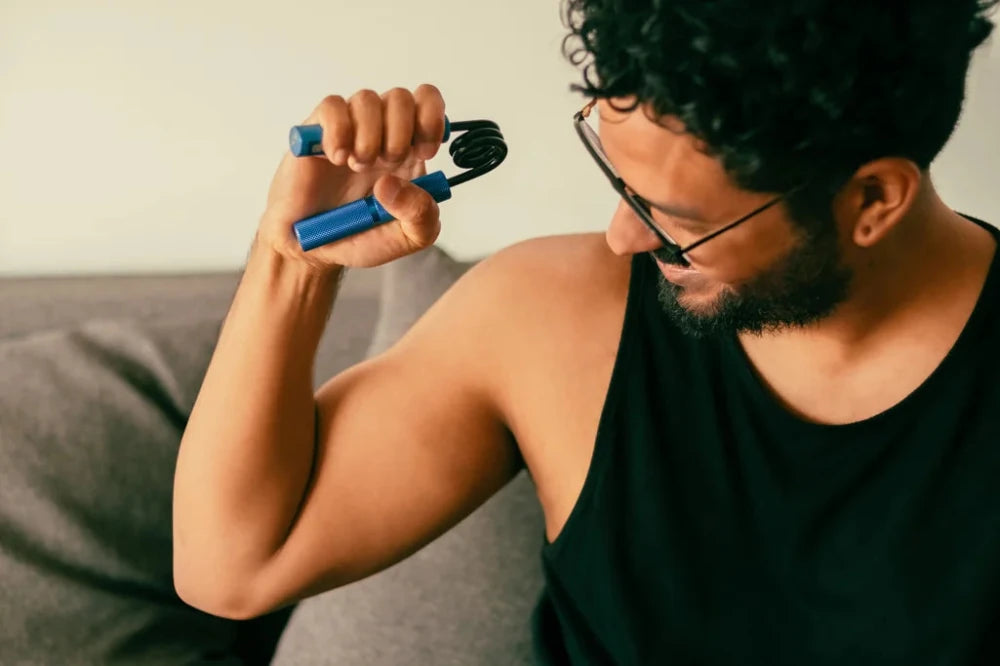

To increase grip strength with a hand gripper, close the handles fully on every rep, train two to three times per week using varied protocols, and move up in resistance once your target reps feel comfortable.
Most people stall because their reps stop short of a full close and their resistance never changes.
Here is how to fix both.
Why Most Hand Gripper Reps Do Not Count
There is one standard that determines whether your training works, and it is simple. The handles have to touch.
Not close, not almost, but properly touching. If a gap remains at the bottom of the rep, you have trained the easy portion of the movement and skipped the range where strength is actually built.
Months of half-reps is the single most common reason people stall, and the second most common is where the gripper sits in the hand.
How to Use a Hand Gripper Correctly
![Gripzilla 'BONE CRUSHER" Individual Gripper - 250LB [USA Only] - Gripzilla - The Best Grip and Forearm Strength Exercises, Arm Wrestling Tools, Hand Grippers to Improve Grip Strength](https://cdn.shopify.com/s/files/1/0272/2408/0419/products/gripzilla-bone-crusher-individual-gripper-250lb-usa-only-848420.jpg?v=1671051147)
- Set the handle at 45 degrees in your palm. A flat, sideways handle makes it nearly impossible to get your pinky onto the end, and the pinky is what finishes the close.
- Position it just above the base of your thumb. If the handle rests directly on the thumb, you lose its contribution at the exact moment you initiate the squeeze.
- Push your fingers as low on the top handle as possible. Part of the pinky hanging slightly off the edge is perfectly fine.
- Keep your fingers tight together with no gaps. Squeezing them into each other creates tension across the whole hand and recruits the muscles around the knuckles far more effectively.
- Use your free hand to hold the setup in place. Release it only once you are ready to squeeze, because a gripper that shifts during setup will cost you the rep.
- Drive deliberately with the pinky. It contributes more crushing force than most people realise, and it tends to give up first as you approach the close.
Correct the setup and a gripper you had written off as too heavy will often close on the first attempt.
Choosing the Right Hand Gripper Resistance
- Beginners should start somewhere between 50 and 100lb, at a resistance they can close cleanly for 8 to 12 reps.
- Intermediate lifters generally work between 100 and 200lb, where clean closes become difficult around the 5 to 8 rep mark.
- Advanced trainees operate at 200lb and above, where a single close is the challenge.
You will need more than one gripper, and that is a training requirement rather than a sales pitch. Heavier resistances build maximum strength while lighter ones handle warm-ups, high reps, drop sets and holds. A single gripper caps your progress within weeks.
The Ultimatum 6-piece kit covers 50lb to 300lb in one set, or you can work up gradually through the full hand gripper range.
If you want a starting point to measure against, our guide on testing grip strength at home takes about five minutes.
5 Hand Gripper Exercises to Build Grip Strength

High reps
Perform 15 to 25 reps per hand with a lighter gripper to build endurance and forearm size. This also works well as a warm-up before heavier sets.
Low reps
Complete 3 to 6 clean closes with a hard gripper, resting a full minute between sets. This is the protocol that raises your maximum, and the 1 to 3 rep range is best reserved for testing.
Eccentrics
Close a heavy gripper using both hands, release one, then resist the opening for 4 to 5 seconds. This overloads your hands beyond their current ceiling and remains the most reliable way through a plateau.
Drop sets
Run a heavy set of 5 to 6 reps, then switch immediately to a lighter gripper and continue to failure. This develops working capacity under fatigue.
Isometric holds
Close the gripper and hold it shut, either for 20 to 30 seconds with a lighter resistance or 3 to 10 seconds with a heavy one. This builds support strength, which is what a heavy deadlift lockout actually demands.
5-Day Hand Gripper Workout Routine
- Day 1. Light gripper, three sets of 15 to 20 reps.
- Day 2. Heavy gripper, four sets of 5 to 6 reps, with the final set dropping to a light gripper until failure.
- Day 3. Moderate gripper, four sets of 8 to 10 reps with a controlled four-second opening on each.
- Day 4. Light gripper, three sets of 20 to 30 second holds.
- Day 5. Heavy gripper, three sets of 3 to 5 eccentric-only reps.
Beginners should run three of these days per week rather than all five. Warm up with 12 to 15 easy reps beforehand, and finish each session by opening your hands against a resistance band for 15 to 20 reps.
How Often Should You Use a Hand Gripper
Muscle recovers quickly, but the tendons and connective tissue in your hands do not.
Two to three intense sessions per week suits most people, while lighter high-rep work can be done more frequently. Training heavy every day tends to produce inflammation and sore knuckles rather than strength.
How to Increase Grip Strength Faster and Break Plateaus
 Progress stops when the demand stops increasing, so escalate in this order.
- Add reps until you comfortably beat the top of your target range.
- Add sets at the same resistance.
- Slow the eccentric to a controlled four seconds.
- Add resistance, which is the change that matters most.
- Add a session, but only once the options above have run out.
If you are stuck on a particular gripper, eccentrics will get you through fastest.
And if your hands are sweating and slipping off the handles before the muscles fail, that is a friction problem rather than a strength problem, which a little liquid chalk will solve.
Hand Gripper Mistakes That Kill Grip Strength Gains
- Training with half-reps, which remains the most common mistake by a wide margin.
- Crushing heavy every day, since tendons need recovery time more than muscle does.
- Never training the opening motion. Grippers work the flexors hard and ignore the extensors completely, and that imbalance often surfaces as elbow pain.
- Expecting one tool to cover everything. A gripper develops crush and support strength, but not pinch, rotation or wrist strength.
- Training through joint pain. Muscle fatigue is normal, whereas sharp pain in the wrist, thumb or elbow is a signal to stop.
That fourth point matters most if size is your goal.
Rotational tools such as the Dynamo and the multi-axis Tornado load the forearm through angles a gripper cannot reach, and we covered the full picture in does a hand gripper build forearms.
Hand Gripper FAQs
How long until you see results?
Most people notice a difference within four to six weeks. Early progress is largely neural as your hands learn to recruit what they already have, after which it becomes a resistance game.
Will a gripper improve your pull-ups?
To a degree. Grippers train crush strength while pull-ups rely on support strength, so weighted dead hangs carry over more directly.
Can you train with a gripper every day?
Light work is fine daily, but heavy crushing is not.
For more variety once the fundamentals are in place, these grip strength workouts extend well beyond the gripper.
Start Squeezing Properly
Set the gripper correctly, close it fully on every rep, rotate through the protocols, add resistance as soon as it starts feeling easy, and give your hands time to recover between sessions.
Weak hands have no place here.
Pick your gripper and start building a crush that means something.