
Eight Mr. Olympia titles. A 800-pound deadlift five weeks out from a show. Arms that measured 22 inches at their peak and still looked vascular under stage lighting.
Ronnie Coleman's arm workout was not built on arm days. It was built on a foundation of strength that most lifters never touch, and the arms were a byproduct.
That is what every other breakdown misses. Here is the actual routine, what made it work, and the part of his training the clips never showed.
How Ronnie Coleman Trained Arms
Ronnie did not have a dedicated arm day.
His Ronnie Coleman arm training was attached to his big compound sessions. Biceps followed back. Triceps followed chest.
By the time he reached his arm work, his muscles were already primed and partially fatigued from deadlifts, rows and presses.
The logic was sound. Compound work recruited the muscles first and built the base strength. Isolation work finished them off. The result was arms that were both powerful and massive, not just pumped in isolation.
He trained six days a week on a rotating split, hitting each muscle group twice.
Ronnie Coleman's Biceps Workout

Biceps were trained on back days, after rows and deadlifts had already tested his grip and pulling strength.
- EZ Bar Standing Curl 21s — 3 sets of 21 reps
- One-Arm Dumbbell Preacher Curl — 3 sets of 10 to 12 reps
- Seated Dumbbell Hammer Curl — 3 sets of 10 to 12 reps
The 21s are worth explaining because they are not just a rep scheme. Seven reps from the bottom to halfway, seven reps from halfway to the top, seven full reps.
Each portion targets the biceps in a different range of motion and the pump by the end of the third portion is unlike anything a standard curl produces.
Ronnie used them to open his biceps workout because they flood the muscle with blood and force every part of the biceps to work.
Preacher curls followed to eliminate momentum and isolate the lower biceps.
Hammer curls finished by hitting the brachialis, the muscle underneath the biceps that pushes them up and adds visible thickness to the arm from the front and side.
Ronnie Coleman's Triceps Workout

Triceps made up roughly two thirds of Ronnie's upper arm size. He knew it and trained them accordingly.
- Skull Crushers — 3 sets of 10 to 12 reps
- Dumbbell Overhead Triceps Extension — 3 sets of 10 to 12 reps
- Dumbbell Kickbacks — 3 sets of 12 to 15 reps
Skull crushers loaded the long head under stretch, which is where most triceps growth comes from.
Overhead extensions kept the long head in a stretched position for the entire movement, doubling down on the part of the muscle that makes arms look thick from behind.
Kickbacks finished with a hard squeeze at full extension.
The Part Nobody Talks About (Forearms and Grip)
Here is what the clips of Ronnie doing curls leave out. The man deadlifted 800 pounds for reps.
He rowed 315 pounds with one arm. He held those loads with a double overhand grip long after most lifters would have switched to straps.
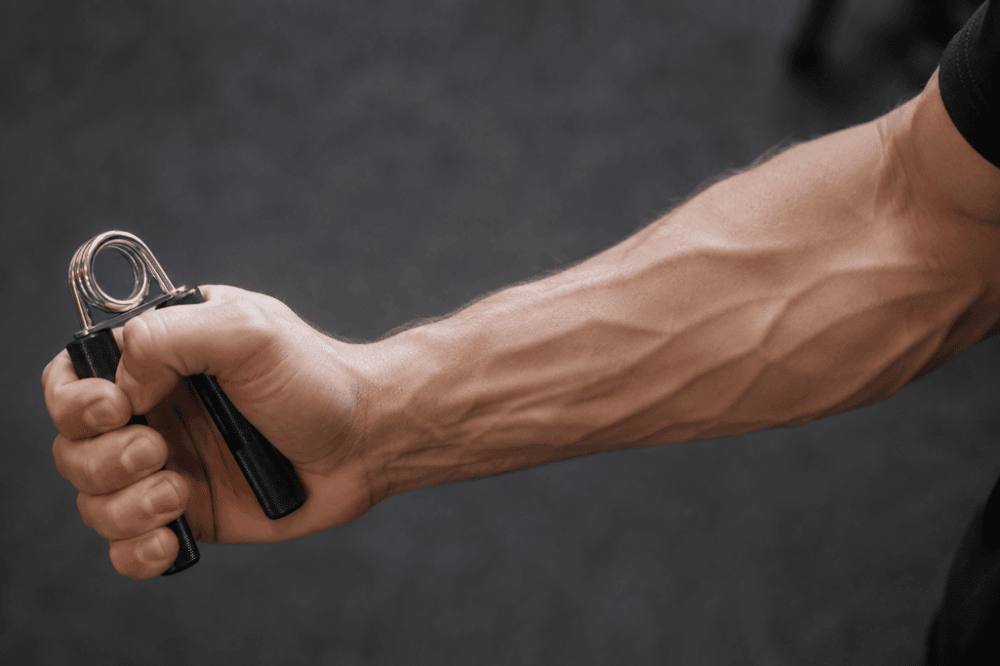
That kind of lifting builds forearms that no isolation exercise can replicate. His forearm density was a direct result of years of pulling insane weight through a full range of motion, without anything to compensate for a weak grip.
Most lifters train biceps and triceps and wonder why their arms still look unfinished. It is almost always the forearms.
They are visible every day, in every shirt, and underdeveloped forearms make even big biceps look incomplete. Ronnie's own forearms ranked among the biggest ever recorded in competitive bodybuilding, and they were built by holding heavy things, not wrist curls at the end of a session.
If you train forearms directly, the two movements that carry over best to this style of training are rotational work and progressive gripper training.
A tool like the Tornado loads the forearm through every angle in a single movement, building the density that barbell and dumbbell work alone misses.
 For crush strength, a progressive gripper set runs the same logic as Ronnie's approach to his lifts: start at a weight you can handle, add resistance over time, and never stop making the demand harder.
What You Can Actually Take From This
Ronnie trained on a level that required recovery capacity most natural lifters do not have. Copying his exact volume will leave you overtrained in two weeks. But the principles hold regardless of how much you lift.
- Train biceps after compound pulling. They will be primed, not cold.
- Train triceps after pressing. Same logic. More efficient stimulus per set.
- Use the 21s. The full-range pump is real and the technique carries over to any biceps training.
- Take grip seriously. Straps have their place, but relying on them exclusively means your forearms never catch up to the rest of your arm.
For a comparison of how this approach stacks up against other legends, the Arnold Schwarzenegger arm workout runs more volume and a dedicated arm day, while Henry Cavill's approach leans on grip endurance and rotational strength.
Ronnie's sits between them: compound-first, heavy, efficient, and built around strength that carries into everything else.
The Workout at a Glance
Biceps (after back training)
- EZ Bar 21s — 3 sets
- One-Arm Preacher Curl — 3 x 10 to 12
- Hammer Curl — 3 x 10 to 12
Triceps (after chest training)
- Skull Crushers — 3 x 10 to 12
- Overhead Dumbbell Extension — 3 x 10 to 12
- Dumbbell Kickback — 3 x 12 to 15
Ronnie Coleman's arms were built by lifting more than most people will ever attempt and recovering from it session after session for years. You cannot replicate that.
But you can apply the same principle: earn your arm size by getting stronger first, and treat your forearms and grip as part of the program rather than an afterthought.
Lightweight, baby. Except it was never lightweight. Build the grip to prove it.