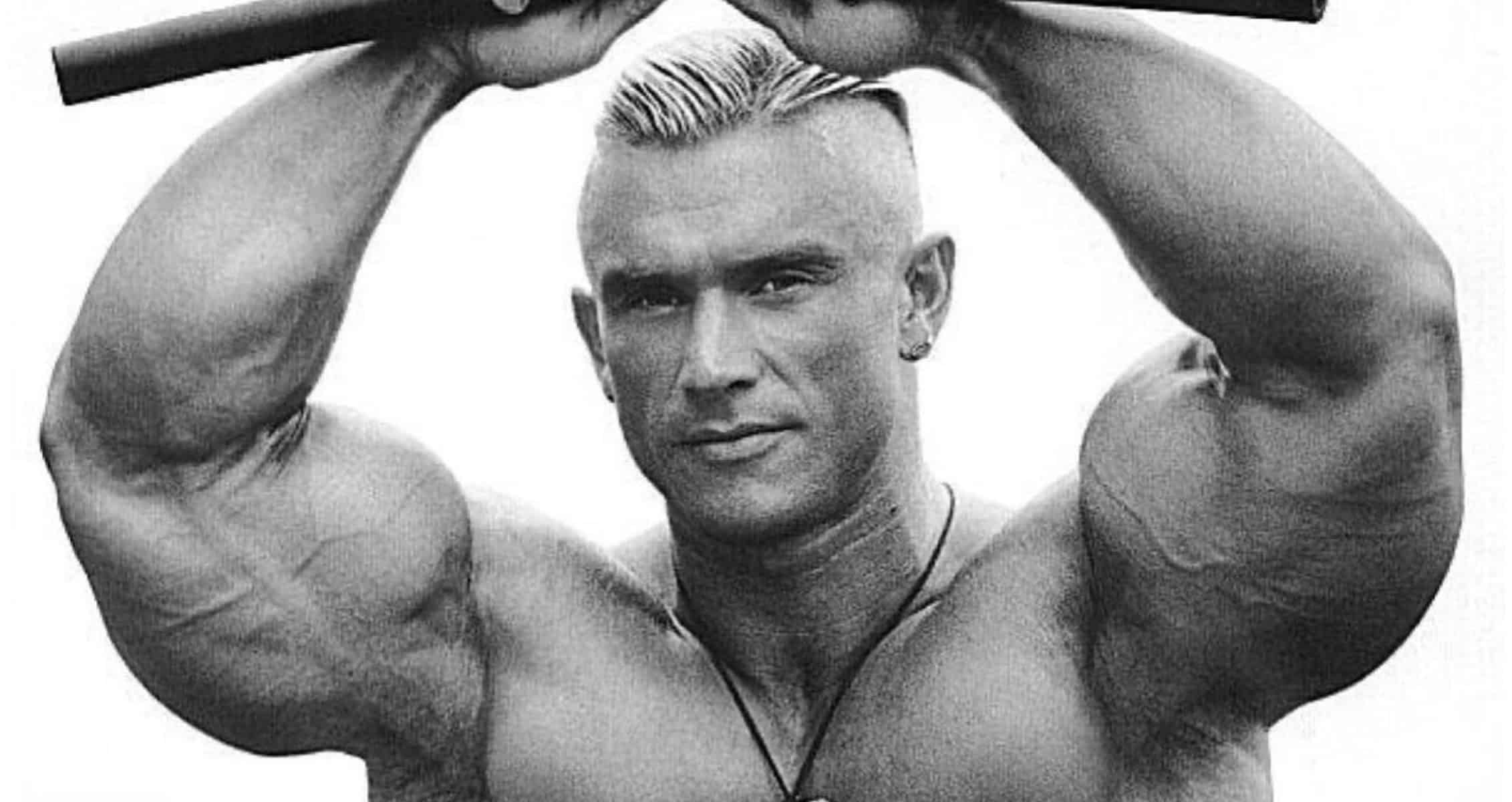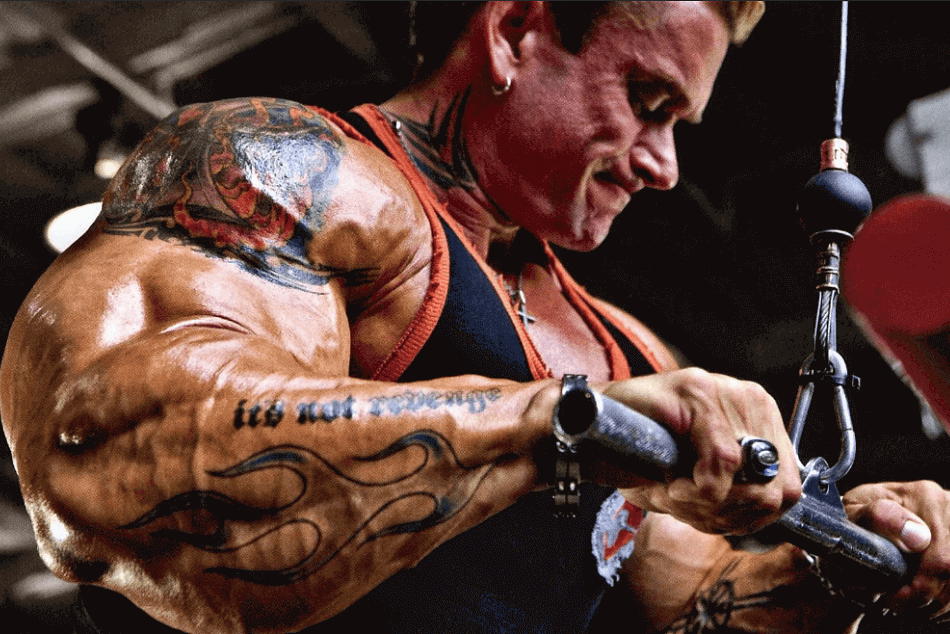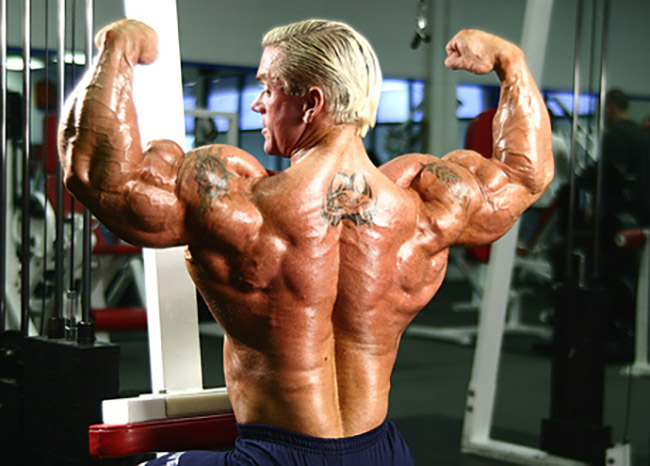

Lee Priest stood 5 feet 4 inches tall and built arms that humbled men a foot taller. That contrast is the entire legend.
The Lee Priest arm workout is studied to this day because Priest, known as The Blonde Myth, owned some of the best arms in bodybuilding on one of the smallest frames the sport has produced. Pound for pound, almost nobody competes.
Below you get the full arm workout routine, the high-volume philosophy that powered it, his real arm size and stats, and the forearm work nearly everyone skips. Let's build.
How Big Were Lee Priest's Arms?

The number is the hook, so let's settle it first.
Lee Priest's Stats and Career:
- Real name: Lee Andrew McCutcheon, nicknamed The Blonde Myth
- Born: 6 July 1972 in Newcastle, Australia
- Height: 5 feet 4 inches (162.5 cm)
- Pro status: earned his IFBB Pro Card at just 20, one of the youngest in history
He was a prodigy. He won IFBB Mr. Australia at 16 and competed at the World's Championships at 17, placing fourth.
He started training at 12 with the help of his mother, herself a bodybuilding competitor, and his grandfather. His best pro win came at the 2006 IFBB Ironman Pro.
Lee Priest's Arm Size
Now the search everyone runs. How big were Lee Priest's arms?
Sources disagree, with some claiming up to 24 inches, but the figure that holds up is around 20 to 22 inches in his prime. Even more impressive, he was still carrying 20-inch-plus arms at age 50.
The raw size matters less than the ratio. Twenty-inch arms on a 5-foot-4 frame is why his peers and fans have repeatedly voted him the man with the best arms in the world.
The Lee Priest Arm Workout Routine

This is a true arm specialization day, built on Priest's own documented fundamentals.
A warning before you start. This program is not for everyone, so only attempt it if you have trained for at least a year.
The format is five biceps and triceps supersets, capped with direct forearm work. Supersetting keeps blood trapped in the arm for a relentless pump.
Superset 1: Heavy Mass Builders
- Standing barbell curls: 4 sets of 6 to 8 reps
- Close-grip bench press: 4 sets of 6 to 8 reps
This is the foundation.
Priest calls standing barbell curls the classic mass builder for biceps and insists they appear in every arm workout, gone heavy, elbows pinned to the sides, with a full contraction at the top and never any cheating.
Superset 2: Stretch and Squeeze
- Two-arm preacher curls: 4 sets of 8 to 10 reps
- Lying triceps extensions (skull crushers): 4 sets of 8 to 10 reps
The second non-negotiable. Priest considers preacher curls, with a barbell or cambered bar, necessary because they place stress on both ends of the biceps belly.
Superset 3: Shaping the Detail
- Seated dumbbell curls: 4 sets of 8 to 10 reps
- Triceps pushdowns: 4 sets of 10 to 12 reps
Dumbbells unlock his shaping trick. By keeping the dumbbell level, supinating it or pronating it, Priest targets the biceps peak, the inner head, the outer head or the brachialis.
Superset 4: The Higher-Rep Burn
- EZ-bar curls: 3 sets of 10 to 20 reps
- Overhead triceps extension: 3 sets of 10 to 20 reps
On the fourth superset you perform EZ curls for the biceps and overhead triceps extension, pushing higher reps on each.
Superset 5: The Finisher
- Alternating hammer curls: 3 sets of 10 to 12 reps
- Single-arm overhead triceps extension: 3 sets of 10 to 12 reps
The final superset pairs alternating hammer curls to hit the biceps with single-arm overhead triceps extension.
Forearm Finisher
- Dumbbell wrist curls: 2 sets to failure
If you have extra time, close the session with two sets of dumbbell wrist curls for the forearms, each taken to failure.
How to Run the Workout?
That is ten-plus movements in one session. This is not a couple of exercises bolted onto an upper body day, it stands alone as its own arm day.
If a dedicated arm day doesn't fit your split, you have options. You can open with chin-ups and dips to pre-load the biceps and triceps, or add the work onto a shoulder day after pressing and lateral raises.
The one rule you do not break: never run this before an important chest or back day, or your arms will fatigue before those bigger muscles get to work.
And the obvious but ignored basic, get enough protein in to fuel the recovery.
Lee Priest's High-Volume Arm Training Philosophy

This is the part most articles miss, and it's where the real size came from.
Why 20 Sets Is His Minimum
Priest is a high-volume believer to the core. His most quoted line:
"Don't buy into the cop-out that small muscle groups need fewer sets. The more sets I do, the more I grow, so 20 sets for biceps is an embarrassing minimum for me."
His true working range ran higher. He usually performed 25 to 35 sets, with 20 sets sitting as the bare floor.
Lee Priest's Rep Ranges for Mass
His rep scheme shifts by tool and goal:
- 6 to 8 reps with barbells and dumbbells when chasing mass
- 10 to 12 reps on cable exercises
- Higher reps on the burnout supersets
How to Scale It Without Getting Hurt?
Reality check. Those 25 to 35 sets belong to an enhanced pro.
If you're doing five to ten sets per week right now, climb gradually, adding a set or two each week while monitoring recovery, slowly working into the high teens and twenties.
Priest even admits the obvious. He does not recommend his own volume unless you're at his level, only that you keep pushing to do more.
Lee Priest's Bicep, Tricep and Forearm Fundamentals

Priest never treated arms as three separate jobs.
Since age 13 he trained biceps, triceps and forearms as one equal package, working from 17 arm fundamentals, 8 for biceps, 5 for triceps and 4 for forearms.
Biceps
His biceps training normally involves four or five exercises, drawn from the basics with no single favorite or essential movement.
The constants are standing barbell curls in every session and two-arm preacher curls for full-belly stress, supported by dumbbell work for peak and head emphasis.
Triceps
His triceps work runs through the proven mass and isolation pieces in the routine above: close-grip bench, lying extensions, pushdowns, and overhead extensions across multiple rep ranges.
The principle mirrors his biceps approach, high volume and varied angles.
Forearms
This is where Priest separates himself.
He prescribes reverse curls for the top of the forearm and wrist curls for the underside, plus hammer curls and twists to spread mass around the entire forearm.
Most lifters do none of this. Priest built some of the best forearms in the sport precisely because he refused to skip it.
Building Lee Priest Forearms
If you want arms that look complete from every angle, the forearm is the piece that finishes the picture, and it's the part Priest obsessed over while everyone else ignored it.
There's a performance reason too. Grinding heavy standing barbell curls and hammer curls taxes your grip hard, and a weak grip ends the set before the muscle is done.
Building serious grip and forearm strength fixes both the look and the limitation.
1. The Gripzilla Tornado trains the rotational, twisting mass Priest chased with his hammer curls and twists.
2. The Gripzilla Dynamo builds wrist and forearm strength through a wringing motion that wrist curls alone can't match.
3. If your curls keep failing at the grip, progressive hand grippers close that gap so you finish every rep.
4. Want every resistance level in one box as you grow? The Gripzilla Ultimatum grip kit covers the full progression.
Pair Priest's biceps and triceps volume with dedicated forearm and grip work, and you build the complete arm he was famous for, not two-thirds of one.
How Often Did Lee Priest Train Arms?
His whole method rests on a few unglamorous basics.
There is no secret set of exercises, no magic rep scheme, just training hard and consistently, using correct form, eating well and getting plenty of sleep.
He also preached focus. During a set of curls you shouldn't be thinking about the song in your headphones or the person next to you, only the pump and building the muscle. And the order rule applies on shared days too.
If you train arms on the same day as a larger muscle group, hit the big muscle first so your arms don't rob it of performance.
Is the Lee Priest Arm Workout Good for Natural Lifters?
The routine itself is sound for any experienced lifter.
The volume, though, needs adjusting.
Priest's 25 to 35 sets and two-hour sessions are an enhanced athlete's workload, and jumping straight to that number invites overtraining and injury rather than growth.
The smart play for a natural lifter:
- Run the five supersets but start at the lower set counts
- Build volume gradually, a set or two per week, while tracking recovery
- Keep Priest's form and pump focus, drop his extreme totals
- Don't program it before key chest or back sessions
Used this way, the Lee Priest arm workout is one of the best high-volume templates you can borrow.
Lee Priest Arm Workout FAQ
How many sets did Lee Priest do for arms?
A minimum of 20 sets for biceps, usually 25 to 35, often across two-hour arm sessions.
What rep range did Lee Priest use?
6 to 8 reps on barbells and dumbbells for mass, 10 to 12 on cables, and higher reps on finishing supersets.
How big were Lee Priest's arms?
Around 20 to 22 inches in his prime, with some reports as high as 24, and still 20-plus at age 50, all on a 5-foot-4 frame.
Is the Lee Priest arm workout good for beginners?
No. It demands at least a year of training. Beginners should build base strength and volume tolerance first.
Did Lee Priest train forearms?
Yes, heavily. He treated forearms as equal to biceps and triceps, using reverse curls, wrist curls, hammer curls and twists.