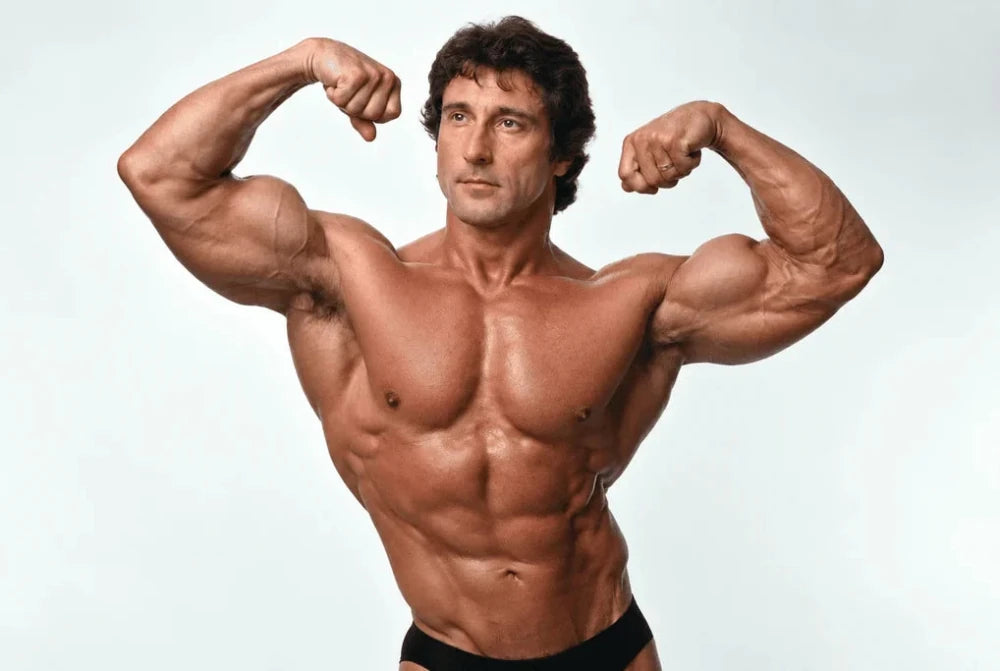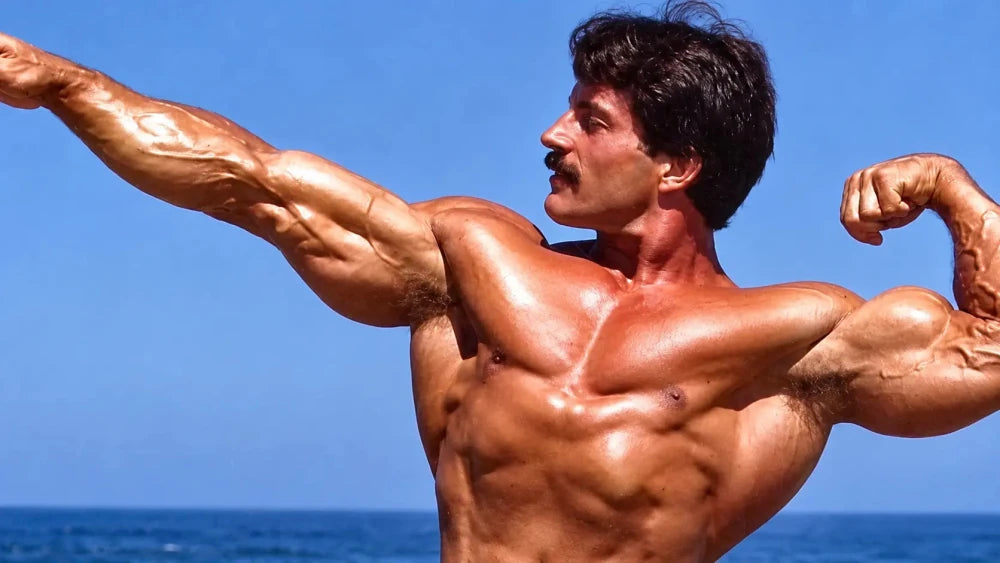

Sergio Oliva warmed up for arms with ten sets of chins to the back of the neck. Not as the workout. As the warm-up, before touching a barbell.
Then came four exercises as straight sets, followed by the same four exercises again as giant sets with no rest between them. Biceps and triceps supersetted throughout. Barbell curls with 200 pounds for five reps.
The Sergio Oliva bicep workout built 23-inch arms in the 1960s, on a physique so complete that Arnold beat him only on arms and only after what most insiders considered a political decision.
Here is the routine as documented at his peak, and the honest assessment of what you can take from it.
Who Sergio Oliva Was
 Born in Guantánamo, Cuba, Oliva did not start in bodybuilding. He came from Olympic weightlifting, and reportedly clean and jerked 400 pounds as a teenager. That performance got him recruited onto the Cuban team for the 1962 Central American and Caribbean Games.
He defected, moved to Chicago, and turned that weightlifting base into three consecutive Mr. Olympia titles. They called him The Myth because the physique did not look like it could be real.
That origin matters for understanding his arms. He built them on top of a foundation of heavy Olympic lifting, which is a very different starting point from a lifter who began with curls.
The Warm-Up Nobody Expects
Oliva considered the warm-up as essential as any advanced technique in the routine, and his was this:
- Chins to the back of the neck — 10 sets, maximum reps each set
Ten sets. To failure. Before the arm workout begins.
Most lifters would call that the entire session. For Oliva it was preparation, and there is real logic in it.
Chins load the biceps under bodyweight through a full range, prime the elbow joint, and flood the upper body with blood before any isolation work starts.
There is also a practical problem buried in it that nobody mentions. Ten sets of chins to failure will destroy your grip long before your biceps are finished.
Anyone attempting this discovers within three sets that their hands, not their lats or arms, are the limiting factor. More on that shortly.
The Sergio Oliva Bicep Workout Structure
 The routine ran in two parts using the same four exercises.
Part One
Regular Sets. Each exercise performed individually, conventional sets and rest periods.
Part Two
Giant Sets. The same four exercises performed back to back with no rest until all four are complete. Rest no more than three minutes, then repeat.
That structure is what separates this from a standard arm day. Part one builds the load. Part two removes recovery entirely and turns the same movements into a metabolic assault.
Biceps and Triceps Trained Together
 Oliva did not separate them. Every exercise was supersetted, pairing a biceps movement directly with a triceps movement.
The template looked like this:
- Standing barbell curl — 8 to 12 reps
- Immediately into triceps extension — 8 to 12 reps
Then rest, then repeat. Alternating opposing muscle groups let one recover while the other worked, which kept total time down and the pump enormous. It is also why his arm sessions produced the kind of swelling that made 23 inches possible.
This is the opposite approach to Mike Mentzer's arm workout, which reduced arm training to three working sets a week. Both built world-class arms. That contradiction is worth sitting with before you commit to either.
Oliva's Documented Working Weights
From his weekly training log at his peak:
- Barbell curl | 200 lb for 5 reps
- Bench press | 380 lb for 8 reps
- Squat | 500 lb for 4 reps
- Press | 200 lb for 15 reps
The curl number is the one that stops people. Two hundred pounds on a straight bar, curled for five reps, in an era before lifting straps were common in bodybuilding.
His Weekly Split
Arms appeared twice a week inside a six-day schedule.
- Monday | Chest and back
- Tuesday | Shoulders, biceps and triceps
- Wednesday | Abs, squats, calves
- Thursday | Chest and back
- Friday | Arms and back
- Saturday | Legs and calves
Marty Gallagher calculates the full programme at roughly 190 sets per week.
For context, most modern hypertrophy guidance sits at 10 to 20 weekly sets per muscle group. Oliva was operating at a volume almost nobody could recover from.
The Part of This Routine That Stops Most People
Here is the practical barrier, and it has nothing to do with biceps strength.
Look at what this routine demands of your hands. Ten sets of chins to failure as a warm-up. Barbell curls heavy enough that holding the bar becomes a task in itself. Four exercises back to back with no rest, then repeat. Arms trained twice weekly on top of rows, chins and heavy bench.
Your grip absorbs every bit of that before your biceps get a single quality rep.
Try the warm-up alone and you will feel it. By set five your fingers are opening. By set eight you are dropping off the bar with your lats and biceps nowhere near failure. The stimulus Oliva was chasing never arrives, because the weakest link gave out first.
Oliva did not have this problem. He came from Olympic weightlifting with a 400-pound clean and jerk behind him, which means his hands were built before his bodybuilding career started. Most lifters copying this routine are starting from the opposite end.
How to Build the Grip This Routine Requires
Three specific gaps, three specific fixes.
1. Your hands open during high-rep chins
That is support grip endurance, the ability to hold under load over time.
Cliff Hang wooden rings train it directly through dead hangs, and the wooden surface is easier on the skin than a bare bar when you are hanging several times a week.
Build your hang time and those ten sets stop being the hard part.
2. You cannot hold heavy curls
That is crush strength, and it responds fast. A graduated gripper set is the most direct tool, and the Ultimatum 6-piece kit runs from 50 lb to 300 lb so your next level is always waiting.
Ten minutes, three times a week. Most people add noticeable crush strength inside six weeks.
3. Your forearms fatigue across giant sets
That is endurance through rotation, not squeezing.
The Dynamo keeps the forearm loaded through a full wringing motion rather than one brief contraction, and the multi-axis Tornado reaches angles a barbell never touches.
Both build the forearm capacity that four back-to-back exercises demand.
These are not accessories to the routine. On a programme this grip-heavy they are the thing that determines whether you complete it or quit halfway through the warm-up.
The four types of grip strength covers why chins, curls and giant sets each need something different, and if you want to know where you currently stand, test your grip at home before your first session.
There is also a bonus. The forearm development that comes with it is the thing that made Oliva's arms look enormous from every angle. Big biceps on thin forearms look unfinished, which is why forearm size matters as much as upper arm mass for the classic look.
A Realistic Version You Can Actually Run
Nobody natural is recovering from 190 sets a week. Here is the structure scaled to something usable.
Warm-up
- Chins to back of neck — 4 sets, max reps (build toward more over months)
Part One — Regular Sets
- Standing barbell curl — 3 x 8 to 12
- Triceps extension — 3 x 8 to 12
- Incline dumbbell curl — 3 x 8 to 12
- Close-grip bench press — 3 x 8 to 12
Part Two — Giant Set
- All four exercises consecutively, no rest
- 3 minutes rest
- 2 rounds
If your biceps have stalled on conventional programming, the common causes are usually recovery and progression rather than exercise selection, and the best arm exercises covers the movements worth building any routine around.
How It Compares to Other Golden Era Arms
Arnold's arm workout ran similarly high volume with a dedicated arm day and more exercise variety. Ronnie Coleman attached arms to compound days and built them on a powerlifting base, which is closer to Oliva's approach than Arnold's.
Jay Cutler trained triceps before biceps and added a dedicated arm day late in his career, calling it his biggest breakthrough.
The common thread across all four is that none of them built arms through curls alone. Every one of them had a heavy pulling and pressing base underneath.
Sergio Oliva Bicep Workout FAQs
How big were Sergio Oliva's arms?
Around 23 inches, extraordinary for the 1960s and still impressive today.
How much could Sergio Oliva curl?
His training logs record 200 lb barbell curls for 5 reps.
How often did he train arms?
Twice a week, on Tuesday with shoulders and Friday with back.
Why did he do chins as an arm warm-up?
Chins load the biceps through a full range under bodyweight, prime the elbow, and fill the upper body with blood before isolation work begins.
Can a natural lifter use this routine?
Not at the original volume. The superset and giant set structure works well at reduced volume, run once a week.
What made Oliva's arms different?
A genuine Olympic weightlifting base, extreme volume, and a grip strong enough to support both.
Build the Hands the Routine Demands
Sergio Oliva's arms started with a 400-pound clean and jerk, not a curl. The foundation came first, and the hands came with it.
That is the part most people skip when they copy a golden era routine. They take the exercises and leave behind the base that made the exercises possible.
If your grip quits before your arms do, the routine cannot work regardless of how faithfully you follow it. Fix that first.
Gripzilla builds the tools that make grip stop being the weak link. Progressive grippers from beginner to elite, forearm trainers that load every angle, and hang equipment built for volume.
Shop the range and give your hands the base the rest of your training is waiting on.