
You rested it. You wore the strap. The pain faded, you went back to training, and a few weeks later, there it was again.
That's not bad luck. It's the most common tennis elbow story there is, and it usually comes down to one thing: the pain goes away faster than the tendon gets strong again.
Rest calms things down, but it doesn't rebuild what your elbow can handle, so the old workload hits an under-prepared tendon and the cycle restarts.
Below are the 7 real reasons it keeps coming back, how often it happens, and a simple way to build back without another flare-up.
We make grip and forearm tools, so we'll also tell you honestly where they help and where they don't.
The Answer in 30 Seconds
- The pain settles faster than the tendon recovers. Feeling fine doesn't mean the tendon is ready for your old workload.
- Rest takes the load off, but it doesn't rebuild strength. When you return to full training, the demand jumps and the problem restarts.
- The cause usually hasn't changed. Same training, same grip volume, same desk, same result.
- Rehab often stops too early. Light exercises are a start, not the finish line.
- Sometimes it isn't tennis elbow at all. If nothing works, get it looked at.
- The way out is slow, steady loading, not more rest and not a quick fix.
The rest of this guide explains each of those, how often it happens, and how to build back so it stays away. We make grip and forearm training tools, so we'll also be honest about where they help and where they don't.
First, What Is Tennis Elbow?
 Tennis elbow is pain on the outside of the elbow. The medical names are lateral epicondylitis or lateral elbow tendinopathy, but it all means the same thing: the common extensor tendon, the tendon your wrist extensor muscles share, is struggling where it attaches to the bone.
Most people with it have never picked up a tennis racket. Lifters, climbers, desk workers, plumbers, painters and pickleball players all get it. (Pickleball elbow is just tennis elbow with a different sport attached.)
It usually hurts when you grip, twist or lift, especially with your palm facing down. Think of opening a jar, turning a door handle, carrying shopping or doing a row.
If the pain is on the inside of the elbow, that's usually golfer's elbow instead. Similar problem, other side.
One more thing worth knowing. It's often described as "tendon irritation," but in longer-lasting cases (what people call chronic tennis elbow) it's less about inflammation and more about the tendon not coping well with load. That detail explains almost everything below.
The 7 Reasons Tennis Elbow Keeps Coming Back
 Here are the possible reasons:
1. The pain went away, but the tendon never got stronger
This is the big one.
Pain is a poor guide to tendon health. It can fade in a couple of weeks. The tendon's ability to handle load (what clinicians call load tolerance) takes much longer to rebuild.
So you feel fine, you go back to normal, and the tendon gets asked to do more than it's ready for.
2. You rested it, but rest alone can't rebuild it
Rest is useful. It calms an angry elbow down.
But resting doesn't make a tendon stronger. It only takes the demand away. The moment the demand returns, so does the problem.
Think of it like taking a month off running and then running your old distance on day one. Your legs wouldn't be happy either.
3. You stopped rehab the moment it stopped hurting
A lot of people do a few wrist exercises, feel better and quietly drop them.
The clinical guideline for lateral elbow pain recommends bringing load back in phases, building strength and endurance as you go, especially if your job or hobby is demanding. Light exercises are the beginning of that process, not all of it.
If your rehab never got as hard as your real life, your elbow is still under-prepared.
4. The thing that caused it never changed
If the same habit caused it, the same habit will bring it back.
The guideline lists several things that raise the risk and that you can change: handling loads over about 20 kg, repeating the same elbow or wrist movement for more than 2 hours a day, and lots of forearm twisting.
In real life that looks like:
- Lifters: grip volume that keeps creeping up, lots of pulling, a sudden new program
- Climbers: big jumps in hangboard or bouldering volume
- Desk workers: a mouse and keyboard set up wrong. Check your ergonomics, like mouse height and wrist position.
- Tradespeople and gardeners: hours of gripping and twisting tools
You can rest all you like. If nothing about the load changes, the tendon sees the same problem again.
5. The rest of your arm isn't doing its share
Your forearm doesn't work alone. Your shoulder and shoulder blade help control the arm.
If they're weak or lazy, your forearm and elbow end up working harder to make up for it. The guideline recommends shoulder and scapular stability training when weakness shows up, alongside wrist extensor strengthening.
So a stubborn elbow can be a clue to look higher up the chain.
6. Quick fixes bought you time, not a solution
A counterforce strap can take the edge off pain during an activity, and some people like it. But the guideline makes no recommendation for braces as a medium or long-term fix, because the evidence is mixed.
A corticosteroid injection can give fast relief. But a large randomised trial published in JAMA in 2013 found worse results at one year, and more recurrence, after a steroid injection compared with a placebo injection. Fast relief and lasting results aren't the same thing, and it's worth asking about that if one is suggested.
Treatments like shockwave are sometimes used for stubborn cases, usually alongside exercise. A clinician can tell you whether they're worth considering for you.
Whatever you choose, the common thread is the same: pain relief on its own won't rebuild the tendon.
7. It might not be tennis elbow at all
Sometimes the pain on the outside of the elbow has another source. A neck problem, an irritated nerve (like radial tunnel syndrome) or a joint issue can feel almost identical.
If you've done the sensible things for a few months and your tennis elbow is not healing, that isn't a sign you're failing. It's a sign to get a proper assessment.
How Often Does Tennis Elbow Actually Come Back?
More often than most people expect.
The 2022 JOSPT clinical practice guideline on lateral elbow pain sums up the research like this:
- 20% to 38% of people still have symptoms, or a recurrence, 6 to 12 months after non-surgical care.
- Recurrence at 2 years is reported as high as 54%.
- Up to 20% have pain for 3 to 5 years.
A population study of medical records found a lower number: about 8.5% had a recurrence within 2 years.
Why the difference? That second study only counts people who went back to a doctor. Plenty of people have a flare-up and just muddle through. So what you'll actually experience, a tennis elbow that comes and goes, probably sits somewhere in between.
The point isn't to scare you. It's that if it's happened twice, you're in very big company, and it's worth having a plan.
If You Lift, Climb or Train Your Grip
Tennis elbow from lifting is one of the most common ways people end up here. So is tennis elbow from deadlifts, from climbing and from too much grip training.
Here's how it tends to creep back in:
- Grip volume sneaks up. One more set of pulls. One more hang. One more heavy carry. Each looks small. Together, they add up.
- Anything new counts as load. A new gripper, a thicker bar, a new pulling variation or a new forearm tool adds stress, even if it feels light.
- Everything at once. The week the pain goes, you jump back to full volume.
- Skipped warm-ups. Cold elbows on the first heavy set is a classic flare-up moment.
- Forgetting the shoulder and upper back. All the forearm work in the world won't help if the rest of the chain is weak.
- Training through the warning signs. If it's worse the next morning, that set was too much.
For the stretches and basic exercises, see our guide to arm stretches for tennis elbow. This guide is about why it returns, and how to stop that.
How Do You Know You're Really Getting Better?
"It doesn't hurt right now" isn't a very reliable test. Try these instead.
- The everyday test. Can you lift the kettle, turn a door handle and shake hands without thinking about your elbow?
- The next-morning test. After training, is your elbow no worse the next day?
- The grip test. Can you hold something firmly for a minute without a flare?
- The twist test. Can you open a stiff jar, or do a controlled wrist rotation, without sharp pain?
- The return test. Can you do your normal training at reduced volume and still feel fine two days later?
If you pass most of those for a few weeks, you're getting somewhere. If you fail them, that's useful information, not a failure. It tells you what step you're on.
How to Stop Tennis Elbow Coming Back? Step by Step
This isn't a prescription, and your clinician may tell you something different. It's a way to build up slowly, so you don't go from "resting" to "full speed" overnight.
Before you begin, get your elbow assessed, especially if it's happened more than once or you have numbness, tingling or pain that isn't improving.
|
Step |
What you're doing |
Move on when |
|
1. Calm it down |
Cut back on what sets it off. Keep the arm gently moving |
Everyday tasks feel easier |
|
2. Start light |
Light, slow wrist-extension work, such as isometric holds, as advised |
Any soreness settles within about a day |
|
3. Build strength |
Slowly add resistance. Work the shoulder and shoulder blade too |
You can train without a flare-up the next day |
|
4. Rebuild grip and twisting |
Add grip, wrist and forearm rotation work in small steps |
Gripping and twisting feel fine, with no lasting pain |
|
5. Go back to your sport |
Return to lifting, climbing or racket sports at lower volume, then build up |
Normal training, no repeated flare-ups |
A few rules of thumb that many clinicians use:
- Mild discomfort while exercising can be okay. Sharp pain, pain that's getting worse or pain that's still there the next day means back off.
- Change one thing at a time.
- Build over weeks, not days.
- Keep going after you feel better. This is the step almost everyone skips, and it's the one that stops the cycle.
The approach with the best evidence behind it is progressive loading. The guideline gives a Grade B recommendation (a solid one) for resisted wrist-extensor exercise, using isometric, concentric and/or eccentric work, for ongoing cases.
Your Comeback Kit
This is where we come in. We make grip and forearm tools, and when you're cleared and ready for steps 4 and 5, a good tool makes the work easier to do in small, adjustable steps.
First, the honest bit. You don't need a tool for the best-backed exercise. Resisted wrist extension works fine with a light dumbbell or a resistance band. If anyone tells you a gadget will fix your elbow, be suspicious.
But if you want to rebuild your grip, wrists and forearms in a way you'll actually stick with, here's how we'd do it.
Start simple with the Gripzilla Dynamo

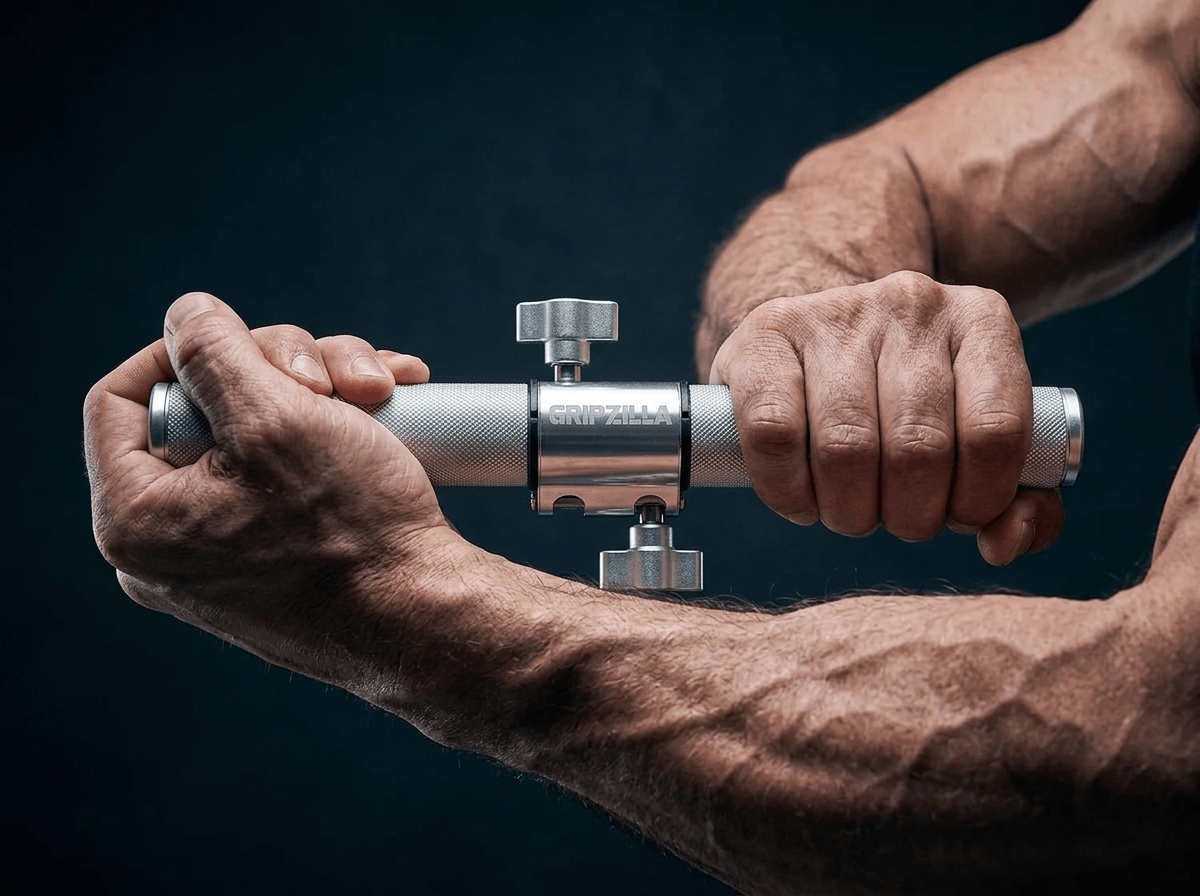
The Gripzilla Dynamo is a wrist roller without weights. No rope, no plates, no rack. You turn a knob to set the resistance, so you can start with it very loose and make it harder bit by bit.
It's quiet, it weighs about 800 g, and it lives happily in a gym bag or a desk drawer. That matters, because the best rehab tool is the one you'll actually use. If you've ever given up on a rope-and-plate wrist roller because the setup was annoying, this fixes that.
Not sure it's for you? Our Dynamo review shows who it suits and who should skip it.
Level up with the Gripzilla Tornado
 When you're ready for more variety, the Gripzilla Tornado is a multi-direction forearm trainer with 18 exercises and more than 100 combinations. It moves your wrist and forearm through many angles, so training stays interesting for months instead of getting stale after two weeks.
Read our Tornado review, or see Tornado vs Dynamo if you're deciding between them.
What to Do When It Flares Up
A tennis elbow flare up doesn't mean you're back to zero. It means the load was a bit too much for now.
- Step back one level. Drop the volume or the resistance. Don't stop everything unless it hurts at rest.
- Find the trigger. New exercise? More volume? A long week at the desk? Write it down.
- Keep the arm gently moving and keep training the parts that don't hurt.
- Give it a few days, then step forward again, slowly.
- If it keeps happening, get it assessed. Repeated flare-ups are information.
When to Get It Checked
Book a doctor or physio if:
- it keeps returning even after sensible, gradual loading
- you have numbness, tingling or weakness, or pain spreading down the arm or into the hand
- you have night pain or pain at rest
- there's swelling, locking or loss of movement
- you had a fall, a "pop" or a clear injury
- you've been struggling for months
A good clinician can check it's really tennis elbow, rule out other causes and build a plan for you. That's often the thing that ends the cycle.
FAQ
Is it normal for tennis elbow to keep coming back?
Yes, it's common. The JOSPT clinical practice guideline reports that 20% to 38% of people have incomplete resolution or recurrence at 6 to 12 months, and recurrence at 2 years has been reported as high as 54%. A study of medical records found a lower figure of about 8.5%, because it only counts people who returned for treatment.
Why won't my tennis elbow go away?
Common reasons include rehab that never progressed, going back to full load too soon, continuing the activity that triggers it, weakness in the shoulder, or pain coming from something other than tennis elbow. If it hasn't improved in a few weeks, get it assessed.
How do I stop tennis elbow coming back?
Build strength gradually instead of relying on rest alone. Progress wrist-extensor exercises, train the shoulder and shoulder blade, change the triggers, increase load slowly and keep up the maintenance work after you feel better. A clinician can tailor the plan to you.
How long does tennis elbow last?
It varies. Some cases settle in weeks, others take months, and a minority last years. Getting the loading right usually matters more than waiting.
Does rest cure tennis elbow?
Rest can calm the pain, but it doesn't rebuild the tendon's ability to handle load, which is why pain often returns when you restart. Most evidence supports gradual loading alongside relative rest.
Do tennis elbow straps work?
A strap can reduce pain during an activity for some people, but the guideline makes no recommendation for braces as a medium or long-term solution because the evidence conflicts. Treat it as a short-term helper.
Do cortisone injections stop tennis elbow coming back?
Not reliably. A large randomised trial found worse one-year outcomes and more recurrence after a steroid injection than after a placebo injection. Talk to your doctor about the pros and cons.
Can lifting or grip training cause tennis elbow?
It can contribute, especially with sudden jumps in grip volume, heavy pulling or new grip tools. Gradual progression and recovery between sessions help lower the risk.
Can I keep training with tennis elbow?
Often yes, with changes. Many clinicians suggest reducing the aggravating movements, training other areas and loading the forearm gradually. Whether it's right for you depends on your diagnosis, so check with a clinician.
Can a wrist roller or forearm trainer help stop tennis elbow coming back?
Once you've been cleared, they can be one way to load the wrist and forearm gradually. They are fitness equipment, not medical devices, and we don't claim they treat or prevent tennis elbow. A light dumbbell or band can do the guideline's main exercise just as well.
When should I see a doctor about recurring tennis elbow?
If the pain keeps returning despite sensible loading, or you have numbness, tingling, weakness, night pain, swelling or pain that spreads, get it checked. A clinician can confirm the diagnosis and rule out other causes.
The Bottom Line
Tennis elbow keeps coming back when pain gets better faster than the tendon does.
The way out isn't more rest or a fancier gadget. It's slow, steady, slightly boring work: calm it down, load it gradually, strengthen the rest of the arm and shoulder, change what set it off, and keep going for a few weeks after you feel fine.
If you've been stuck in the loop for months, get it assessed. Then build back at a pace your elbow can handle. And when you're cleared and ready to rebuild your grip, we'll have a tool that starts light and grows with you.
Ready for your next step? See the Dynamo wrist roller or Tornado forearm trainer.