
Grip strength for longevity is one of the most powerful health predictors science has found. See what the research says.
You open a jar. You carry groceries. You shake someone's hand. Seems like pretty ordinary stuff, right?
But here's the thing, how hard you can squeeze your hand might be one of the most powerful clues science has about how long you're going to live.
Not blood pressure. Not cholesterol. Not your BMI. Your grip.
Let's break down exactly what the research says, what it means for you, and what you can actually do about it.
What Is Grip Strength and Why Does It Matter for Longevity?
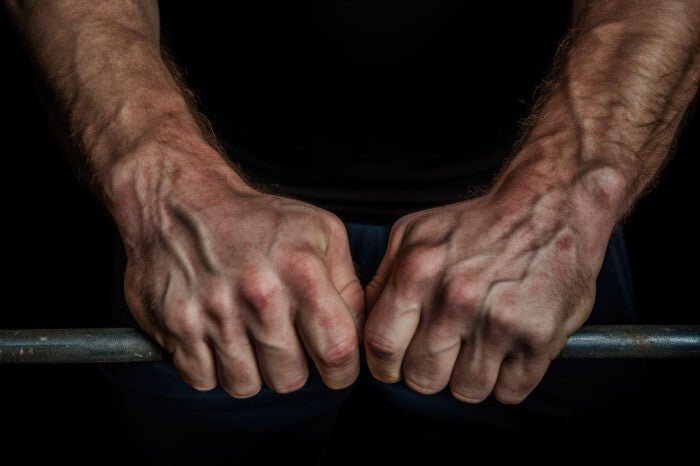
 Grip strength is simply the amount of force your hand and forearm muscles can generate when you squeeze.
It's usually measured with a device called a dynamometer. You squeeze it as hard as you can and it gives you a number in kilograms or pounds.
Simple test. But what it reveals is anything but simple.
Researchers have found that grip strength acts as a window into your entire body. It reflects your muscle mass, your nervous system health, your cardiovascular function, your hormonal balance, basically, how well your biology is holding up.
That's why doctors and scientists have started calling it a biomarker of aging. If you want to understand how this test actually works, we've put together a full breakdown of what a handgrip strength test measures and how to improve your score.
The Science (Grip Strength Predicts All-Cause Mortality)
 This isn't anecdotal. The evidence here is enormous.
A landmark study called the PURE study tracked over 140,000 adults across 17 countries. The finding?
Grip strength predicted death from all causes, including heart disease and cancer, more powerfully than systolic blood pressure. That's a big deal, because blood pressure has been a gold-standard health marker for decades.
Another major meta-analysis looked at 42 studies covering over 3 million participants. The result: for every 5 kg drop in grip strength, there was a 16% higher risk of dying from any cause, and a 21% increased risk of cardiovascular death, independent of age, smoking, and other lifestyle factors.
And a separate meta-analysis of 33 studies found that people with higher grip strength had a 31% lower risk of all-cause mortality than those with weaker grip.
The pattern is consistent across Japan, the US, Korea, Europe, and beyond. This isn't a fluke. Weak grip = real health risk.
We've covered this connection in more depth in our article on how grip strength is important to your health.
Why Is Grip Strength Such a Powerful Predictor of Lifespan?
Great question. You'd think grip strength is just about your hands. So why does it predict your heart disease risk?
Here's why it works as a whole-body health signal:
It reflects your total muscle mass. Grip strength is highly correlated with the amount of lean muscle you carry throughout your body.
More muscle = better metabolic health, better insulin sensitivity, lower inflammation. When your grip weakens, it usually means you're losing muscle system-wide, a process called sarcopenia.
It mirrors your nervous system. The ability to generate force requires your brain and muscles to communicate properly. Declining grip is often an early sign that this neuromuscular connection is degrading.
It tracks cardiovascular health. Strong grip is linked to better vascular function, lower inflammation, healthier endothelial function, and more stable heart rhythm.
Weak grip, on the other hand, signals the kind of systemic dysfunction that shows up later as heart attacks or strokes.
It reflects your biological age, not just your birthday. A 2023 study found that weaker grip strength was associated with accelerated DNA methylation age, which is a lab-based measurement of how fast your cells are aging. Stronger people tend to have a lower biological age than their chronological age.
In short: your grip tells the story of your body's overall condition.
Grip Strength and Heart Disease Risk
 Let's zoom into the heart stuff because it's striking.
Studies consistently show that low grip strength is associated with higher risk of heart attack, stroke, cardiovascular death, and poor recovery after cardiac events.
One of the most cited findings is that grip strength is a stronger predictor of cardiovascular mortality than blood pressure. Blood pressure drugs are among the most commonly prescribed in the world. Yet this simple squeeze test outperforms them as a predictor.
Why? Grip strength captures something blood pressure can't, the state of your muscles, your inflammation levels, your insulin resistance, and your nervous system, all at once.
Grip Strength and Cancer Risk
 This one surprises people.
Low grip strength has also been linked to higher cancer mortality. While it doesn't mean grip strength causes or prevents cancer, it does mean that the underlying biological conditions, muscle loss, systemic inflammation, immune dysfunction, that show up as weak grip also make the body more vulnerable to cancer-related complications.
Muscle tissue plays an active role in immune regulation. When you lose muscle, you lose a key part of your body's defense system.
Grip Strength and Cognitive Decline
The connection between grip and your brain is real too.
Several studies have found that older adults with lower grip strength perform worse on memory, attention, and executive function tests. And weaker grip is associated with a higher risk of developing dementia.
The muscle-brain connection likely works through shared pathways: inflammation, vascular health, insulin signaling. What's bad for your muscles tends to be bad for your brain over time.
What's a Normal Grip Strength by Age?
Here's a rough guide for healthy adults measured with a dynamometer:
|
Age Group |
Men (kg) |
Women (kg) |
|
20–29 |
46–56 |
28–36 |
|
30–39 |
46–56 |
28–36 |
|
40–49 |
42–52 |
26–34 |
|
50–59 |
37–47 |
23–31 |
|
60–69 |
31–42 |
20–28 |
|
70+ |
25–37 |
17–25 |
A score below the 25th percentile for your age and sex is generally considered low and worth paying attention to.
For a much deeper dive into these numbers, including what they mean for your daily life, check out our full guide on average grip strength by age.
For rough reference: below 35 lbs (16 kg) for women and below 59 lbs (27 kg) for men are commonly used clinical thresholds for low grip strength.
When Does Grip Strength Start to Decline?
 Grip strength peaks somewhere in your late 20s to mid-30s, then stays relatively stable for a while. The real decline typically kicks in around age 50, and accelerates after 60–65.
But here's the important part: this decline is not inevitable. It's heavily influenced by how active you are, how much strength training you do, how well you sleep, what you eat, and your overall lifestyle.
People who stay active and do resistance training can maintain strong grip well into their 70s and 80s.
If you're already over 60 and feeling your grip slipping, our article on grip strength exercises for elderly has a practical, beginner-friendly program you can start today.
Can You Improve Grip Strength If It's Already Weak?
Yes, and this is important.
Even in older adults, studies show that targeted resistance training significantly improves grip strength. It's not too late at 60, 70, or even 80. The body responds to training at any age, the adaptations just come a little slower.
If you're starting from a low baseline or dealing with an injury or recovering from a medical condition, it's worth checking out our piece on home arm therapy equipment, many of the same tools used for rehab also double as excellent grip trainers for longevity.
Small consistent improvements compound over years into meaningful protection.
The Bottom Line on Grip Strength and Longevity
Grip strength is one of the most accessible, affordable, and informative health metrics available. You can test it in 30 seconds with a simple tool.
The research is clear: people with stronger grips live longer, have fewer chronic diseases, better heart health, sharper minds, and more functional independence as they age.
You don't need to become a powerlifter. You just need to keep moving, keep lifting, and treat your muscles like the long-term investment they are.
Whether you start with the Gripzilla Tornado for rotational forearm training, the hand grippers for progressive crushing strength, or the complete Ultimatum kit, the most important thing is that you start.
Because in the most literal sense, your life may depend on the strength of your grip.